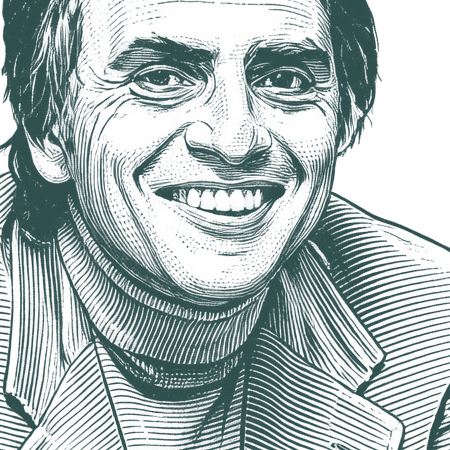
Pokochaliśmy gwiazdy tak czule, że nie musimy lękać się nocy. - Carl Sagan
""
Pokochaliśmy gwiazdy tak czule, że nie musimy lękać się nocy.
Polish
Collect this quote
About
Carl Sagan
Carl Edward Sagan (9 November 1934 – 20 December 1996) was an American astronomer, planetary scientist, cosmologist, astrophysicist, astrobiologist, author, and science communicator. His best known scientific contribution is research on extraterrestrial life, including experimental demonstration of the production of amino acids from basic chemicals by radiation. Sagan assembled the first physical messages sent into space, the Pioneer plaque and the Voyager Golden Record, universal messages that could potentially be understood by any extraterrestrial intelligence that might find them. Sagan argued the hypothesis, accepted since, that the high surface temperatures of Venus can be attributed to, and calculated using, the greenhouse effect. He testified to the US Congress in 1985 that the greenhouse effect will change the earth's climate system.
Biography information from
Wikiquote·
Portrait adapted from
Wikimedia Commons, NASA/JPL (Public domain / CC0)
Also Known As
Native Name:
Carl Edward Sagan
Alternative Names:
Sagan
•
Carl E. Sagan
•
Carl E Sagan
•
C. E. Sagan
•
C.E. Sagan
•
C E Sagan
•
C. Sagan
•
C Sagan
•
Sagan C
•
Sagan C.
•
Sagan C. E.
•
Sagan CE
Our global civilisation is clearly on the edge of failure and the most important task it faces, preserving the lives and well-being of its citizens and the future habitability of the planet. But if we're willing to live with the growing likelihood of nuclear war shouldn't we also been willing to explore vigorously every possible means to prevent nuclear war. Shouldn't we consider in every nation major changes in the traditional ways of doing things, a fundamental restructuring of economic political social and religious institutions. We've reached a point where there can be no more special interests or special cases, nuclear arms threaten every person on the Earth. Fundamental changes in society are sometimes labelled impractical or contrary to human nature, as if nuclear war were practical or as if there's only one human nature. But fundamental changes can clearly be made, we're surrounded by them. In the last two centuries abject slavery which was with us for thousands of years has almost entirely been eliminated in a stirring worldwide revolution. Women, systematically mistreated for millennia are gradually gaining the political and economic power traditionally denied them and some wars of aggression have recently been stopped or curtailed because of a revulsion felt by the people in the aggressor nations. The old appeals to racial, sexual, and religious chauvinism and to rabid nationalist fervor are beginning not to work. A new consciousness is developing which sees the earth as a single organism and recognizes that an organism at war with itself is doomed. We are one planet. One of the great revelations of the age of space exploration is the image of the earth finite and lonely, somehow vulnerable, bearing the entire human species through the oceans of space and time.
We knew the Moon from our earliest days. It was there when our ancestors descended from the trees into the savannahs, when we learned to walk upright, when we first devised stone tools, when we domesticated fire, when we invented agriculture and built cities and set out to subdue the Earth.
Limited Time Offer
Premium members can get their quote collection automatically imported into their Quotewise collections.