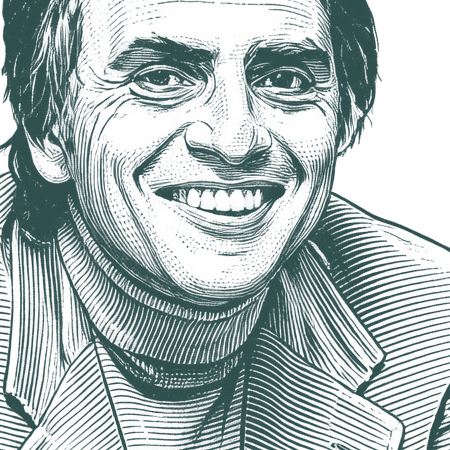
universe is almost incompatible with life — or at least what we understand as necessary for life: Even if every star in a hundred billion galaxies ha… - Carl Sagan
""
universe is almost incompatible with life — or at least what we understand as necessary for life: Even if every star in a hundred billion galaxies had an Earthlike planet, without heroic technological measures life could prosper in only about 10-37 the volume of the Universe. For clarity, let’s write it out: only 0.000 000 000 000 000 000 000 000 000 000 000 000 1 of our universe is hospitable to life. Thirty-six zeroes before the one. The rest is cold, radiation-riddled black vacuum.
English
Collect this quote
About
Carl Sagan
Carl Edward Sagan (9 November 1934 – 20 December 1996) was an American astronomer, planetary scientist, cosmologist, astrophysicist, astrobiologist, author, and science communicator. His best known scientific contribution is research on extraterrestrial life, including experimental demonstration of the production of amino acids from basic chemicals by radiation. Sagan assembled the first physical messages sent into space, the Pioneer plaque and the Voyager Golden Record, universal messages that could potentially be understood by any extraterrestrial intelligence that might find them. Sagan argued the hypothesis, accepted since, that the high surface temperatures of Venus can be attributed to, and calculated using, the greenhouse effect. He testified to the US Congress in 1985 that the greenhouse effect will change the earth's climate system.
Biography information from
Wikiquote·
Portrait adapted from
Wikimedia Commons, NASA/JPL (Public domain / CC0)
Also Known As
Native Name:
Carl Edward Sagan
Alternative Names:
Sagan
•
Carl E. Sagan
•
Carl E Sagan
•
C. E. Sagan
•
C.E. Sagan
•
C E Sagan
•
C. Sagan
•
C Sagan
•
Sagan C
•
Sagan C.
•
Sagan C. E.
•
Sagan CE
Those at too great a distance may, I am well aware, mistake ignorance for perspective.
For unknown ages after the explosive outpouring of matter and energy of the Big Bang, the Cosmos was without form. There were no galaxies, no planets, no life. Deep, impenetrable darkness was everywhere, hydrogen atoms in the void. Here and there, denser accumulations of gas were imperceptibly growing, globes of matter were condensing-hydrogen raindrops more massive than suns. Within these globes of gas was kindled the nuclear fire latent in matter. A first generation of stars was born, flooding the Cosmos with light. There were in those times, not yet any planets to receive the light, no living creatures to admire the radiance of the heavens. Deep in the stellar furnaces, the alchemy of nuclear fusion created heavy elements from the ashes of hydrogen burning, the atomic building blocks of future planets and lifeforms. Massive stars soon exhausted their stores of nuclear fuel. Rocked by colossal explosions, they returned most of their substance back into the thin gas from which they had once condensed. Here in the dark lush clouds between the stars, new raindrops made of many elements were forming, later generation of stars being born. Nearby, smaller raindrops grew, bodies far too little to ignite the nuclear fire, droplets in the interstellar mist on their way to form planets. Among them was a small world of stone and iron, the early Earth. Congealing and warming, the Earth released methane, ammonia, water and hydrogen gases that had been trapped within, forming the primitive atmosphere and the first oceans. Starlight from the Sun bathed and warmed the primeval Earth, drove storms, generated lightning and thunder. Volcanoes overflowed with lava. These processes disrupted molecules of the primitive atmosphere; the fragments fell back together into more and more complex forms, which dissolved into the early oceans. After a while the seas achieved the consistency of a warm, dilute soup. Molecules were organized, and complex chemical reactions driven, on the surface o
Limited Time Offer
Premium members can get their quote collection automatically imported into their Quotewise collections.
Mi smo ovdašnje utjelovljenje jednog kozmosa koji je izrastao do samosvijesti. Počeli smo razmišljati o našem porijeklu: zvjezdana tvar koja razmišlja o zvijezdama; organizirani skupovi od deset milijardi milijarda atoma koji razmišljaju o evoluciji atoma slijedeći u mislima dugi put na kraju kojeg je, barem ovdje, niknula svijest. Naša je odanost upućena ljudskoj vrsti i planetu. Mi govorimo u ime Zemlje. Obavezu da preživimo ne dugujemo samo sebi samima već i tom kozmosu, prostranom i golemom iz kojeg smo ponikli.