For I dipt into the future,
far as human eye could see,
Saw the Vision of the world, and all the wonder that would be;
Saw the heavens fill with commerce, argosies of magic sails,
Pilots of the purple twilight, dropping down with costly bales;
Heard the heavens fill with shouting, and there raind a ghastly dew
From the nations airy navies grappling in the central blue;
Far along the world-wide whisper of the south-wind rushing warm,
With the standards of the peoples plunging thro the thunder-storm;
Till the war-drums throbbd, no longer, and the battle-flags were furled
In the Parliament of man, the Federation of the world.
There the common sense of most shall hold a fretful realm in awe,
And the kindly earth shall slumber, lapt in universal law.
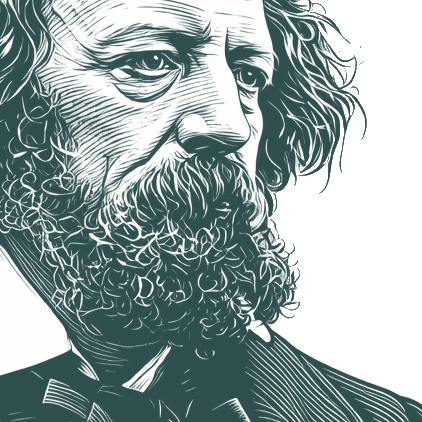
British Poet Laureate (1809–1892)
Alfred Tennyson, 1st Baron Tennyson (6 August 1809 – 6 October 1892) was the Poet Laureate of the United Kingdom during much of Queen Victoria's reign, after William Wordsworth, and is one of the most popular English poets.
Bio from: Wikiquote (CC BY-SA 4.0) · Portrait adapted from: Wikimedia Commons, Julia Margaret Cameron / Adam Cuerden (Public domain / CC0)
Native Name:
Alfred Tennyson, 1. Baron Tennyson
Alternative Names:
Alfred Tennyson, 1st Baron Tennyson
•
Lord Alfred Tennyson
•
Alcibiades
•
A. Tennyson
•
Alfred Tennyson, Baron Tennyson
•
Alfred Tennyson Tennyson
•
Tennyson
•
1st Baron Tennyson of Aldworth and Freshwater Alfred Tennyson
•
Alfred Tennyson d'Eyncourt
•
Lord Tennyson Alfred
•
Alfred Lord Tennyson
•
Alfred, Lord Tennyson
•
Alfred (Lord)
From Wikidata (CC0)
Showing quotes in randomized order to avoid selection bias. Click Popular for most popular quotes.
Ring out, wild bells, to the wild sky,
The flying cloud, the frosty light:
The year is dying in the night;
Ring out, wild bells, and let him die.
Ring out the old, ring in the new,
Ring, happy bells, across the snow:
The year is going, let him go;
Ring out the false, ring in the true.
Ring out the grief that saps the mind,
For those that here we see no more;
Ring out the feud of rich and poor,
Ring in redress to all mankind.
Ring out a slowly dying cause,
And ancient forms of party strife;
Ring in the nobler modes of life,
With sweeter manners, purer laws.
Ring out the want, the care, the sin,
The faithless coldness of the times;
Ring out, ring out my mournful rhymes,
But ring the fuller minstrel in.
Ring out false pride in place and blood,
The civic slander and the spite;
Ring in the love of truth and right,
Ring in the common love of good.
Ring out old shapes of foul disease;
Ring out the narrowing lust of gold;
Ring out the thousand wars of old,
Ring in the thousand years of peace.
Ring in the valiant man and free,
The larger heart, the kindlier hand;
Ring out the darkness of the land,
Ring in the Christ that is to be
In that still place she, hoarded in herself, Grew, seldom seen: not less among us lived Her fame from lip to lip. Who had not heard Of Rose, the Gardener’s daughter? Where was he, So blunt in memory, so old at heart, At such a distance from his youth in grief, That, having seen, forgot? The common mouth, So gross to express delight, in praise of her Grew oratory. Such a lord is Love, And Beauty such a mistress of the world.