These men and women remind us that heroism is found not only on the fields of battle. They remind us that heroism does not require special training or physical strength. Heroism is here, all around us, in the hearts of so many of our fellow citizens, just waiting to be summoned — as it was on Saturday morning.
president of the United States from 2009 to 2017 (born 1961)
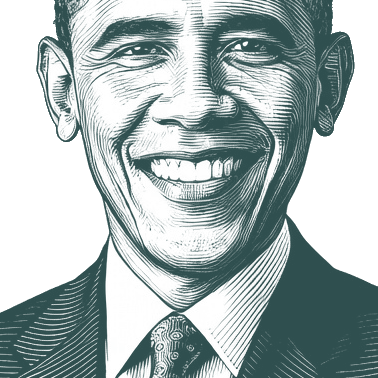
Barack Hussein Obama II (born August 4, 1961) is an American politician who served as the 44th president of the United States of America from 2009 to 2017. Born in Hawaii, the son of a Kenyan father and a mother from Kansas, he won the 2008 presidential election and was re-elected president in November 2012. A member of the U.S. Democratic Party, he was the first African American president. Before becoming president, he represented the 13th district for three terms in the Illinois Senate from 1997 to 2004 and served as United States senator from Illinois between January 4, 2005 and November 16, 2008. While president, he was the recipient of the 2009 Nobel Peace Prize.
Bio from: Wikiquote (CC BY-SA 4.0) · Portrait adapted from: Wikimedia Commons, Official White House Photo by Pete Souza (Public domain / CC0)
Birth Name:
Barack Hussein Obama II
Also Known As:
Barry
Alternative Names:
POTUS 44
•
Barack Hussein Obama
•
Barack H. Obama
•
Barack Hussein Obama, Jr.
•
Barack H Obama
•
Barak Obama
•
Barry Obama
•
Barack Obama II
From Wikidata (CC0)

Showing quotes in randomized order to avoid selection bias. Click Popular for most popular quotes.
Because corruption holds back every aspect of economic and civil life. It’s an anchor that weighs you down and prevents you from achieving what you could. If you need to pay a bribe and hire somebody’s brother -- who’s not very good and doesn’t come to work -- in order to start a business, well, that’s going to create less jobs for everybody. If electricity is going to one neighborhood because they’re well-connected, and not another neighborhood, that’s going to limit development of the country as a whole. If someone in public office is taking a cut that they don't deserve, that’s taking away from those who are paying their fair share. So this is not just about changing one law -- although it's important to have laws on the books that are actually being enforced. It’s important that not only low-level corruption is punished, but folks at the top, if they are taking from the people, that has to be addressed as well. But it's not something that is just fixed by laws, or that any one person can fix. It requires a commitment by the entire nation -- leaders and citizens -- to change habits and to change culture. [...] People who break the law and violate the public trust need to be prosecuted. NGOs have to be allowed to operate who shine a spotlight on what needs to change. And ordinary people have to stand up and say, enough is enough.
I have seen, the desperation and disorder of the powerless: how it twists the lives of children on the streets of Jakarta or Nairobi in much the same way as it does the lives of children on Chicago’s South Side, how narrow the path is for them between humiliation and untrammeled fury, how easily they slip into violence and despair. I know that the response of the powerful to this disorder — alternating as it does between a dull complacency and, when the disorder spills out of its proscribed confines, a steady, unthinking application of force, of longer prison sentences and more sophisticated military hardware — is inadequate to the task. I know that the hardening of lines, the embrace of fundamentalism and tribe, dooms us all.
Because in big and diverse societies like ours, progress ultimately depends on something more basic, and that is how we see each other. And we know from experience what makes nations strong. And Neha I think did a great job of describing the essence of what’s important here. We are strongest when we see the inherent dignity in every human being.
We can acknowledge that oppression will always be with us, and still strive for justice. We can admit the intractability of deprivation, and still strive for dignity. Clear-eyed, we can understand that there will be war, and still strive for peace. We can do that — for that is the story of human progress; that's the hope of all the world; and at this moment of challenge, that must be our work here on Earth.
And this is probably a good place for me to end by just saying that the issue of climate change is a perfect example of why young people have to lead. Because old people, they've created a mess, and then they'll be gone. And then you -- (applause) -- you're the ones who have to deal with it. And also what happens is old people get set in their ways. So the older you get, the more likely you are to say, that's how it's always been so that's how I'm going to keep on doing it -- even if there's a better way to do things. Young people, they're asking, well, why do I have to do it that way? Let's try it this way. And that kind of willingness to accept challenges and try things in a new way, to not be stuck in the past, or to look towards the future, that's what all of you represent.
Those of us who have had the singular privilege to hold the office of the Presidency know well that progress in this country can be hard and it can be slow, frustrating and sometimes you’re stymied. The office humbles you. You’re reminded daily that in this great democracy, you are but a relay swimmer in the currents of history, bound by decisions made by those who came before, reliant on the efforts of those who will follow to fully vindicate your vision. But the presidency also affords a unique opportunity to bend those currents -- by shaping our laws and by shaping our debates; by working within the confines of the world as it is, but also by reimagining the world as it should be.
On this day, we honor not just those who’ve worn this country’s uniform, but the men and women who’ve died in its service; who’ve laid down their lives in defense of their fellow citizens; who’ve given their last full measure of devotion to protect the United States of America. These are the men and women I will be honoring this weekend, and I know many of you are doing the same.
We have a better story to tell. But to say that our vision for the future is better is not to say that it will inevitably win. Because history also shows the power of fear. History shows the lasting hold of greed and the desire to dominate others in the minds of men. Especially men. History shows how easily people can be convinced to turn on those who look different, or worship God in a different way. So, if we’re truly to continue Madiba’s long walk towards freedom, we’re going to have to work harder and we’re going to have to be smarter.