president of the United States from 2009 to 2017 (born 1961)
Barack Hussein Obama II (born August 4, 1961) is an American politician who served as the 44th president of the United States of America from 2009 to 2017. Born in Hawaii, the son of a Kenyan father and a mother from Kansas, he won the 2008 presidential election and was re-elected president in November 2012. A member of the U.S. Democratic Party, he was the first African American president. Before becoming president, he represented the 13th district for three terms in the Illinois Senate from 1997 to 2004 and served as United States senator from Illinois between January 4, 2005 and November 16, 2008. While president, he was the recipient of the 2009 Nobel Peace Prize.
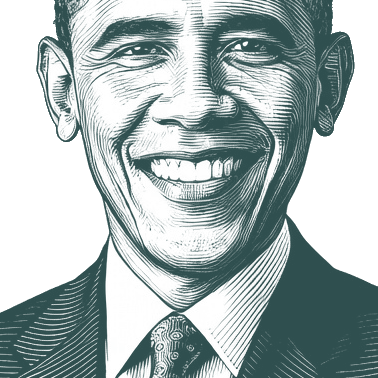
Bio from: Wikiquote (CC BY-SA 4.0) · Portrait adapted from: Wikimedia Commons, Official White House Photo by Pete Souza (Public domain / CC0)
From Wikidata (CC0)

But for all those who scratched and clawed their way to get a piece of the American Dream, there were many who didn't make it - those who were ultimately defeated, in one way or another, by discrimination. That legacy of defeat was passed on to future generations - those young men and increasingly young women who we see standing on street corners or languishing in our prisons, without hope or prospects for the future. Even for those blacks who did make it, questions of race, and racism, continue to define their world-view in fundamental ways. For the men and women of Reverend Wright’s generation, the memories of humiliation and doubt and fear have not gone away; nor has the anger and the bitterness of those years. That anger may not get expressed in public, in front of white co-workers or white friends. But it does find voice in the barbershop, or the beauty shop, or around the kitchen table. At times, that anger is exploited by politicians, to gin up votes along racial lines, or to make up for a politician's own failing. And occasionally it finds voice in the church on Sunday morning, in the pulpit and in the pews. The fact that so many people are surprised to hear that anger in some of Reverend Wright's sermons simply reminds us of the old truism that the most segregated hour of American life occurs on Sunday morning.
But what you’ve also seen is a trend in the United States but also around the world in which even when the economy grows, it tends to benefit a lot of people at the very top, but the vast majority of people, they don't benefit as much. And you're starting to see bigger and bigger gaps in inequality and in wealth and in opportunity. And that's true not just in the United States, it's true in Europe; it's long been true in parts of Asia; it's been true in Latin America. And I believe that economies work best when growth and development is broad-based, when it's shared -- when ordinary people, if they work hard and they take responsibility, they can succeed. Not everybody is going to be rich, but everybody should be able to live a good life. Not everybody is going to be a billionaire, but everybody should be able to have a nice home and educate their children and feel some sense of security.
People of Berlin — and people of the world — the scale of our challenge is great. The road ahead will be long. But I come before you to say that we are heirs to a struggle for freedom. We are a people of improbable hope. With an eye toward the future, with resolve in our hearts, let us remember this history, and answer our destiny, and remake the world once again.
Clem understood that justice grows out of recognition of ourselves in each other. That my liberty depends on you being free, too. That history can’t be a sword to justify injustice, or a shield against progress, but must be a manual for how to avoid repeating the mistakes of the past -- how to break the cycle. A roadway toward a better world. He knew that the path of grace involves an open mind -- but, more importantly, an open heart. That’s what I’ve felt this week -- an open heart. That, more than any particular policy or analysis, is what’s called upon right now, I think -- what a friend of mine, the writer Marilynne Robinson, calls “that reservoir of goodness, beyond, and of another kind, that we are able to do each other in the ordinary cause of things.” That reservoir of goodness. If we can find that grace, anything is possible. If we can tap that grace, everything can change.
There was a team that took that bullet out of the baby, 15 years ago. She's got a scar on her arm, always will, but she will survive. Just like America will survive. Just like black folks will survive. We won't forget where we came from. We won't forget what happened 19 months ago, or 15 years ago, or 300 years ago. We know who the head surgeon is, we're on the case, we're going to pull bullet after bullet out.
One election will not fix everything that needs to be fixed, but it will be a start. And you have to start it. What’s going to fix our democracy is you. People ask me, what are you going to do for the election? No, the question is: what are you going to do? You’re the antidote. Your participation and your spirit and your determination, not just in this election but in every subsequent election, and in the days between elections.
For everywhere we look, there is work to be done. The state of the economy calls for action, bold and swift, and we will act — not only to create new jobs, but to lay a new foundation for growth. We will build the roads and bridges, the electric grids and digital lines that feed our commerce and bind us together. We will restore science to its rightful place, and wield technology's wonders to raise health care's quality and lower its cost. We will harness the sun and the winds and the soil to fuel our cars and run our factories. And we will transform our schools and colleges and universities to meet the demands of a new age. All this we can do. And all this we will do.
The [Bush] Administration's failure to be consistently involved in helping Israel achieve peace with the Palestinians has been both wrong for our friendship with Israel, as well as badly damaging to our standing in the Arab world. I do not pretend to have all the answers to this vexing problem, and untangling the issues involved is an appropriate topic for a separate speech. What I can say is this: not only must we be consistent, but we will not succeed unless we have the cooperation of the European Union and the Arab States in pressing for reforms within the Palestinian community.