People of Berlin — and people of the world — the scale of our challenge is great. The road ahead will be long. But I come before you to say that we are heirs to a struggle for freedom. We are a people of improbable hope. With an eye toward the future, with resolve in our hearts, let us remember this history, and answer our destiny, and remake the world once again.
president of the United States from 2009 to 2017 (born 1961)
Barack Hussein Obama II (born August 4, 1961) is an American politician who served as the 44th president of the United States of America from 2009 to 2017. Born in Hawaii, the son of a Kenyan father and a mother from Kansas, he won the 2008 presidential election and was re-elected president in November 2012. A member of the U.S. Democratic Party, he was the first African American president. Before becoming president, he represented the 13th district for three terms in the Illinois Senate from 1997 to 2004 and served as United States senator from Illinois between January 4, 2005 and November 16, 2008. While president, he was the recipient of the 2009 Nobel Peace Prize.
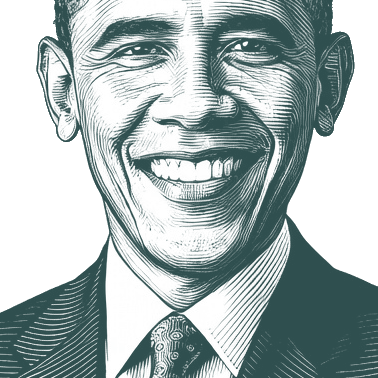
Bio from: Wikiquote (CC BY-SA 4.0) · Portrait adapted from: Wikimedia Commons, Official White House Photo by Pete Souza (Public domain / CC0)
Birth Name:
Barack Hussein Obama II
Also Known As:
Barry
Alternative Names:
POTUS 44
•
Barack Hussein Obama
•
Barack H. Obama
•
Barack Hussein Obama, Jr.
•
Barack H Obama
•
Barak Obama
•
Barry Obama
•
Barack Obama II
From Wikidata (CC0)

Showing quotes in randomized order to avoid selection bias. Click Popular for most popular quotes.
Now, before I begin, I'd just like to clear the air about that little controversy everybody was talking about a few weeks back. I have to tell you, I really thought this was much ado about nothing, but I do think we all learned an important lesson. I learned never again to pick another team over the Sun Devils in my NCAA brackets. It won't happen again. President Crow and the board of regents will soon learn all about being audited by the IRS.
Toot showed me how to balance a checkbook and resist buying stuff I didn’t need. She was the reason why, even in my most revolutionary moments as a young man, I could admire a well-run business and read the financial pages, and why I felt compelled to disregard overly broad claims about the need to tear things up and remake society from whole cloth. She taught me the value of working hard and doing your best even when the work was unpleasant, and about fulfilling your responsibilities even when doing so was inconvenient. She taught me to marry passion with reason, to not get overly excited when life was going well, and to not get too down when it went badly. All this was instilled in me by an elderly, plainspoken white lady from Kansas. It was her perspective that often came to mind when I was campaigning, and her worldview that I sensed in many of the voters I encountered, whether in rural Iowa or in a Black neighborhood in Chicago, that same quiet pride in sacrifices made for children and grandchildren, the same lack of pretension, the same modesty of expectations.
Democracy is sometimes messy, and for leaders, sometimes it's frustrating. Democracy means that somebody is always complaining about something. Nobody is ever happy in a democracy about their government. If you make one person happy, somebody else is unhappy. Then sometimes somebody who you made happy, later on, now they’re not happy. They say, what have you done for me lately? But that's the nature of democracy. That's why it works, is because it's constantly challenging leaders to up their game and to do better.
Change is hard –- in our own lives, and in the lives of nations. And change is even harder when we carry the heavy weight of history on our shoulders. But today we are making these changes because it is the right thing to do. Today, America chooses to cut loose the shackles of the past so as to reach for a better future –- for the Cuban people, for the American people, for our entire hemisphere, and for the world.
Peace is not merely the absence of visible conflict. Only a just peace based on the inherent rights and dignity of every individual can truly be lasting. It was this insight that drove drafters of the Universal Declaration of Human Rights after the Second World War. In the wake of devastation, they recognized that if human rights are not protected, peace is a hollow promise.
Even though we come from different places, we share common dreams: to choose our leaders; to live together in peace; to get an education and make a good living; to love our families and our communities. That’s why freedom is not an abstract idea; freedom is the very thing that makes human progress possible -- not just at the ballot box, but in our daily lives. One of our greatest Presidents in the United States, Franklin Delano Roosevelt, understood this truth. He defined America’s cause as more than the right to cast a ballot. He understood democracy was not just voting. He called upon the world to embrace four fundamental freedoms: freedom of speech, freedom of worship, freedom from want, and freedom from fear. These four freedoms reinforce one another, and you cannot fully realize one without realizing them all.
There’s still enormous problems in our society. But democracy is the way that we solve them. That's how we got health care for more of our people. That's how we made enormous gains in women’s rights and gay rights. That's how we address the inequality that concentrates so much wealth at the top of our society. Because workers can organize and ordinary people have a voice, American democracy has given our people the opportunity to pursue their dreams and enjoy a high standard of living.