president of the United States from 2009 to 2017 (born 1961)
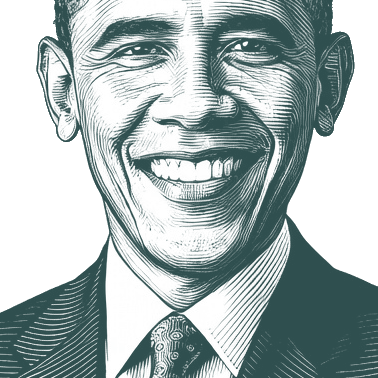
Barack Hussein Obama II (born August 4, 1961) is an American politician who served as the 44th president of the United States of America from 2009 to 2017. Born in Hawaii, the son of a Kenyan father and a mother from Kansas, he won the 2008 presidential election and was re-elected president in November 2012. A member of the U.S. Democratic Party, he was the first African American president. Before becoming president, he represented the 13th district for three terms in the Illinois Senate from 1997 to 2004 and served as United States senator from Illinois between January 4, 2005 and November 16, 2008. While president, he was the recipient of the 2009 Nobel Peace Prize.
Bio from: Wikiquote (CC BY-SA 4.0) · Portrait adapted from: Wikimedia Commons, Official White House Photo by Pete Souza (Public domain / CC0)
From Wikidata (CC0)

Part of our job, together, is to work to reject such extremism that infects too many of our young people. Part of that effort must be a continued rejection by Muslims of those who distort Islam to preach intolerance and promote violence, and it must also a rejection by non-Muslims of the ignorance that equates Islam with terror.
I receive this honor with deep gratitude and great humility. It is an award that speaks to our highest aspirations — that for all the cruelty and hardship of our world, we are not mere prisoners of fate. Our actions matter, and can bend history in the direction of justice. And yet I would be remiss if I did not acknowledge the considerable controversy that your generous decision has generated. In part, this is because I am at the beginning, and not the end, of my labors on the world stage. Compared to some of the giants of history who've received this prize — Schweitzer and King; Marshall and Mandela — my accomplishments are slight. And then there are the men and women around the world who have been jailed and beaten in the pursuit of justice; those who toil in humanitarian organizations to relieve suffering; the unrecognized millions whose quiet acts of courage and compassion inspire even the most hardened cynics. I cannot argue with those who find these men and women — some known, some obscure to all but those they help — to be far more deserving of this honor than I. But perhaps the most profound issue surrounding my receipt of this prize is the fact that I am the Commander-in-Chief of the military of a nation in the midst of two wars. One of these wars is winding down. The other is a conflict that America did not seek; one in which we are joined by 42 other countries — including Norway — in an effort to defend ourselves and all nations from further attacks. Still, we are at war, and I'm responsible for the deployment of thousands of young Americans to battle in a distant land. Some will kill, and some will be killed. And so I come here with an acute sense of the costs of armed conflict — filled with difficult questions about the relationship between war and peace, and our effort to replace one with the other.
Advanced Search Filters
Filter search results by source, date, and more with our premium search tools.
I have been a consistent and strong opponent of this war. I have also tried to act responsibly in that opposition to ensure that, having made the decision to go into Iraq, we provide our troops, who perform valiantly, the support they need to complete their mission. I have also stated publicly that I think we have both strategic interests and humanitarian responsibilities in ensuring that Iraq is as stable as possible under the circumstances. Finally, I said publicly that it is my preference not to micromanage the Commander-in-Chief in the prosecution of war. Ultimately, I do not believe that is the ideal role for Congress to play. But at a certain point, we have to draw a line. At a certain point, the American people have to have some confidence that we are not simply going down this blind alley in perpetuity. When it comes to the war in Iraq, the time for promises and assurances, for waiting and patience is over. Too many lives have been lost and too many billions have been spent for us to trust the President on another tried-and-failed policy, opposed by generals and experts, opposed by Democrats and Republicans, opposed by Americans and even the Iraqis themselves. It is time to change our policy. It is time to give Iraqis their country back, and it is time to refocus America's effort on the wider struggle against terror yet to be won.
It's the dreamers -- no matter how humble or poor or seemingly powerless -- that are able to change the course of human events. We saw it in South Africa, where citizens stood up to the scourge of apartheid. We saw it in Europe, where Poles marched in Solidarity to help bring down the Iron Curtain. In Argentina, where mothers of the disappeared spoke out against the Dirty War. It’s the story of my country, where citizens worked to abolish slavery, and establish women’s rights and workers’ rights, and rights for gays and lesbians.
I will never forget who this victory truly belongs to. It belongs to you. It belongs to you. I was never the likeliest candidate for this office. We didn't start with much money or many endorsements. Our campaign was not hatched in the halls of Washington. It began in the backyards of Des Moines and the living rooms of Concord and the front porches of Charleston. It was built by working men and women who dug into what little savings they had to give $5 and $10 and $20 to the cause. It grew strength from the young people who rejected the myth of their generation's apathy who left their homes and their families for jobs that offered little pay and less sleep. It drew strength from the not-so-young people who braved the bitter cold and scorching heat to knock on doors of perfect strangers, and from the millions of Americans who volunteered and organized and proved that more than two centuries later a government of the people, by the people, and for the people has not perished from the Earth. This is your victory. And I know you didn't do this just to win an election. And I know you didn't do it for me. You did it because you understand the enormity of the task that lies ahead. For even as we celebrate tonight, we know the challenges that tomorrow will bring are the greatest of our lifetime — two wars, a planet in peril, the worst financial crisis in a century. Even as we stand here tonight, we know there are brave Americans waking up in the deserts of Iraq and the mountains of Afghanistan to risk their lives for us.
My fellow Americans, the oath I have sworn before you today, like the one recited by others who serve in this Capitol, was an oath to God and country, not party or faction. And we must faithfully execute that pledge during the duration of our service. But the words I spoke today are not so different from the oath that is taken each time a soldier signs up for duty or an immigrant realizes her dream. My oath is not so different from the pledge we all make to and that fills our hearts with pride. They are the words of citizens and they represent our greatest hope. You and I, as citizens, have the power to set this country’s course. You and I, as citizens, have the obligation to shape the debates of our time -- not only with the votes we cast, but with the voices we lift in defense of our most ancient values and enduring ideals.
Limited Time Offer
Premium members can get their quote collection automatically imported into their Quotewise collections.
As we meet here today, men and women and children are being tortured, detained and murdered by the Syrian regime. Thousands have been killed, many during the holy time of Ramadan. Thousands more have poured across Syria’s borders. The Syrian people have shown dignity and courage in their pursuit of justice -- protesting peacefully, standing silently in the streets, dying for the same values that this institution is supposed to stand for. And the question for us is clear: Will we stand with the Syrian people, or with their oppressors?