I've seen how a spirit of unity, born of tragedy, can gradually dissipate, overtaken by the return to business as usual, by inertia and old habits and expediency. I see how easily we slip back into our old notions, because they’re comfortable, we’re used to them. I’ve seen how inadequate words can be in bringing about lasting change. I’ve seen how inadequate my own words have been. And so I’m reminded of a passage in *John’s Gospel [First John]: Let us love not with words or speech, but with actions and in truth. If we’re to sustain the unity we need to get through these difficult times, if we are to honor these five outstanding officers who we’ve lost, then we will need to act on the truths that we know. And that’s not easy. It makes us uncomfortable. But we’re going to have to be honest with each other and ourselves.
president of the United States from 2009 to 2017 (born 1961)
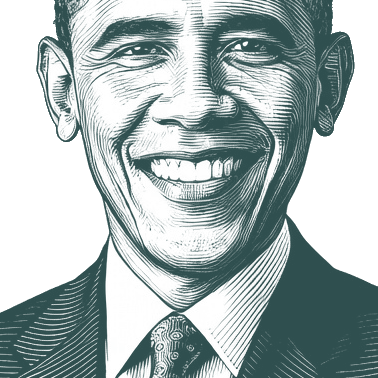
Barack Hussein Obama II (born August 4, 1961) is an American politician who served as the 44th president of the United States of America from 2009 to 2017. Born in Hawaii, the son of a Kenyan father and a mother from Kansas, he won the 2008 presidential election and was re-elected president in November 2012. A member of the U.S. Democratic Party, he was the first African American president. Before becoming president, he represented the 13th district for three terms in the Illinois Senate from 1997 to 2004 and served as United States senator from Illinois between January 4, 2005 and November 16, 2008. While president, he was the recipient of the 2009 Nobel Peace Prize.
Bio from: Wikiquote (CC BY-SA 4.0) · Portrait adapted from: Wikimedia Commons, Official White House Photo by Pete Souza (Public domain / CC0)
Birth Name:
Barack Hussein Obama II
Also Known As:
Barry
Alternative Names:
POTUS 44
•
Barack Hussein Obama
•
Barack H. Obama
•
Barack Hussein Obama, Jr.
•
Barack H Obama
•
Barak Obama
•
Barry Obama
•
Barack Obama II
From Wikidata (CC0)

Showing quotes in randomized order to avoid selection bias. Click Popular for most popular quotes.
Trayvon Martin could have been me thirty five years ago. And when you think about why, in the African-American community at least, there is lot of pain about what happened. I think it is important to recognize that the African-American community is looking at the issue through a set of experiences and a history, that doesn’t go away. There are very few African-American men in this country who haven’t had the experience of being followed when they are shopping at a department store. That includes me. There are very few African-American men in this country who haven’t had the experience of walking across the street and hearing the locks click on the doors of cars. That happens to me at least before I was a senator. There are very few African-Americans who haven’t had the experience of getting on an elevator and a woman clutching her purse nervously and holding her breath until she had a chance to get off.
What’s at stake in this debate goes far beyond a few months of headlines, or passing tensions in our foreign policy. When you cut through the noise, what’s really at stake is how we remain true to who we are in a world that is remaking itself at dizzying speed. Whether it’s the ability of individuals to communicate ideas; to access information that would have once filled every great library in every country in the world; or to forge bonds with people on other sides of the globe, technology is remaking what is possible for individuals, and for institutions, and for the international order. So while the reforms that I have announced will point us in a new direction, I am mindful that more work will be needed in the future. One thing I’m certain of: This debate will make us stronger. And I also know that in this time of change, the United States of America will have to lead. It may seem sometimes that America is being held to a different standard. And I'll admit the readiness of some to assume the worst motives by our government can be frustrating. No one expects China to have an open debate about their surveillance programs, or Russia to take privacy concerns of citizens in other places into account. But let’s remember: We are held to a different standard precisely because we have been at the forefront of defending personal privacy and human dignity.
This victory alone is not the change we seek. It is only the chance for us to make that change. And that cannot happen if we go back to the way things were. It can't happen without you, without a new spirit of service, a new spirit of sacrifice. So let us summon a new spirit of patriotism, of responsibility, where each of us resolves to pitch in and work harder and look after not only ourselves but each other.
If you still don’t like Obamacare -- and I know you don’t even though it’s built on market-based ideas of choice and competition in the private sector, then you should explain how, exactly, you’d cut costs, and cover more people, and make insurance more secure. You owe it to the American people to tell us what you are for, not just what you’re against. That way we can have a vigorous and meaningful debate. That’s what the American people deserve. That’s what the times demand. It’s not enough anymore to just say we should just get our government out of the way and let the unfettered market take care of it -- for our experience tells us that’s just not true.
As for our common defense, we reject as false the choice between our safety and our ideals. Our Founding Fathers, faced with perils we can scarcely imagine, drafted a charter to assure the rule of law and the rights of man, a charter expanded by the blood of generations. Those ideals still light the world, and we will not give them up for expedience's sake. And so to all other peoples and governments who are watching today, from the grandest capitals to the small village where my father was born: know that America is a friend of each nation and every man, woman, and child who seeks a future of peace and dignity, and that we are ready to lead once more.
Racism persists. Inequality persists. Don’t worry — I’m going to get to that. But I wanted to start, Class of 2016, by opening your eyes to the moment that you are in. If you had to choose one moment in history in which you could be born, and you didn’t know ahead of time who you were going to be — what nationality, what gender, what race, whether you’d be rich or poor, gay or straight, what faith you'd be born into — you wouldn’t choose 100 years ago. You wouldn’t choose the fifties, or the sixties, or the seventies. You’d choose right now. If you had to choose a time to be, in the words of Lorraine Hansberry, “young, gifted, and black” in America, you would choose right now. I tell you all this because it's important to note progress. Because to deny how far we’ve come would do a disservice to the cause of justice, to the legions of foot soldiers; to not only the incredibly accomplished individuals who have already been mentioned, but your mothers and your dads, and grandparents and great grandparents, who marched and toiled and suffered and overcame to make this day possible. I tell you this not to lull you into complacency, but to spur you into action — because there’s still so much more work to do, so many more miles to travel. And America needs you to gladly, happily take up that work.
None of these challenges can be solved quickly or easily. But all of them demand that we listen to one another and work together; that we focus on our common interests, not on occasional differences; and that we reaffirm our shared values, which are stronger than any force that could drive us apart. That is the work that we must carry on.
And to protect the freedom of all the voters, those in power must accept constraints. That's what our American system is designed to do. Now, America may have the strongest military in the world, but it must submit to civilian control. I, as the President of the United States, make determinations that the military then carries out, not the other way around. As President and Commander-In-Chief, I have that responsibility because I'm accountable to the people.