Now that we’d improved our competitive position, we went on the offensive. In my weekly staff meeting, I inserted an agenda item titled “What Are We Not Doing?” Ordinarily in a staff meeting, you spend lots of time reviewing, evaluating, and improving all of the things that you do: build products, sell products, support customers, hire employees, and the like. Sometimes, however, the things you’re not doing are the things you should actually be focused on.
American businessman
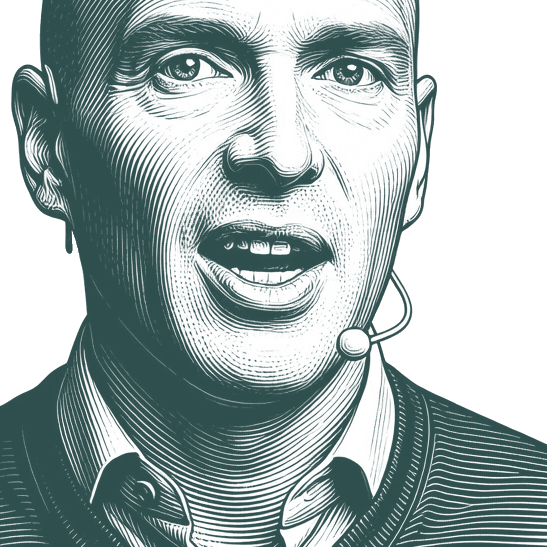
Ben Horowitz (born June 13, 1966) is an American businessman, investor, blogger, and author.
Bio from: Wikiquote (CC BY-SA 4.0) · Portrait adapted from: Wikimedia Commons, TechCrunch (CC BY)
Alternative Names:
Benjamin Abraham Horowitz
From Wikidata (CC0)
Showing quotes in randomized order to avoid selection bias. Click Popular for most popular quotes.
Peacetime CEO knows that proper protocol leads to winning. Wartime CEO violates protocol in order to win. Peacetime CEO focuses on the big picture and empowers her people to make detailed decisions. Wartime CEO cares about a speck of dust on a gnat’s ass if it interferes with the prime directive. Peacetime CEO builds scalable, high-volume recruiting machines. Wartime CEO does that, but also builds HR organizations that can execute layoffs. Peacetime CEO spends time defining the culture. Wartime CEO lets the war define the culture.
When you scale an organization, you will also need to give ground grudgingly. Specialization, organizational structure, and process all complicate things and implementing them will feel like you are moving away from common knowledge and quality communication. It is very much like the offensive lineman taking a step backward. You will lose ground, but you will prevent your company from descending into chaos.
In good organizations, people can focus on their work and have confidence that if they get their work done, good things will happen for both the company and them personally. It is a true pleasure to work in an organization such as this. Every person can wake up knowing that the work they do will be efficient, effective, and make a difference for the organization and themselves. These things make their jobs both motivating and fulfilling.
“In a poor organization, on the other hand, people spend much of their time fighting organizational boundaries, infighting, and broken processes. They are not even clear on what their jobs are, so there is no way to know if they are getting the job done or not. In the miracle case that they work ridiculous hours and get the job done, they have no idea what it means for the company or their careers. To make it all much worse and rub salt in the wound, when they finally work up the courage to tell management how fucked-up their situation is, management denies there is a problem, then defends the status quo, then ignores the problem.
Finally, be clear in your own mind about your expectations for this person upon joining your company. What will this person do in the first thirty days? What do you expect their motivation to be for joining? Do you want them to build a large organization right away or hire only one or two people over the next year?
Jim Collins, in his bestselling book Good to Great, demonstrates through massive research and comprehensive analysis that when it comes to CEO succession, internal candidates dramatically outperform external candidates. The core reason is knowledge. Knowledge of technology, prior decisions, culture, personnel, and more tends to be far more difficult to acquire than the skills required to manage a larger organization. Collins does not, however, explain why internal candidates sometimes fail as well. I will attempt to do so here. I will focus the discussion on two core skills for running an organization: First, knowing what to do. Second, getting the company to do what you know. While being a great CEO requires both skills, most CEOs tend to be more comfortable with one or the other. I call managers who are happier setting the direction of the company Ones and those who more enjoy making the company perform at the highest level Twos.
As we thought about what would make us both better and different, two core ideas greatly influenced our thinking: First, technical founders are the best people to run technology companies. All of the long-lasting technology companies that we admired — Hewlett-Packard, Intel, Amazon, Apple, Google, Facebook — had been run by their founders. More specifically, the innovator was running the company. Second, it was incredibly difficult for technical founders to learn to become CEOs while building their companies. I was a testament to that. But, most venture capital firms were better designed to replace the founder than to help the founder grow and succeed.
Ironically, the biggest obstacle to putting a training program in place is the perception that it will take too much time. Keep in mind that there is no investment that you can make that will do more to improve productivity in your company. Therefore, being too busy to train is the moral equivalent of being too hungry to eat. Furthermore, it’s not that hard to create basic training courses.
Works in ChatGPT, Claude, or Any AI
Add semantic quote search to your AI assistant via MCP. One command setup.
Does the CEO know what to do in all matters all the time? This includes matters of personnel, financing, product strategy, goal sizing, and marketing. At a macro level, does the CEO set the right strategy for the company and know its implications in every detail of the company? I evaluate two distinct facets of knowing what to do: Strategy In good companies, the story and the strategy are the same thing. As a result, the proper output of all the strategic work is the story. Decision making At the detailed level, the output of knowing what to do is the speed and quality of the CEO’s decisions.