I mused for a few moments on the question of which was worse, to lead a life so boring that you are easily enchanted or a life so full of stimulus that you are easily bored. But then it occurred to me that musing is a pointless waste of anyone's time, and instead I went off to see if I could find a Baby Ruth candy bar, a far more profitable exercise.
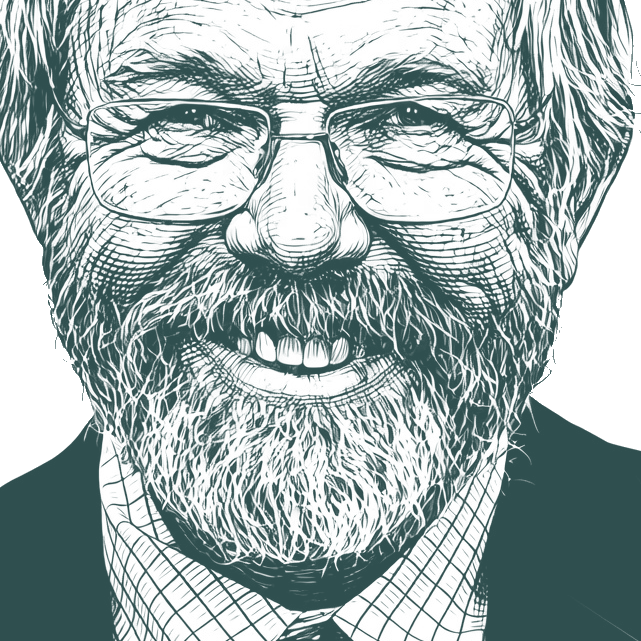
American-British author (born 1951)
William "Bill" McGuire Bryson, OBE (born December 8, 1951) is a best-selling American author of humorous books on travel, as well as books on the English language and on scientific subjects.
Bio from: Wikiquote (CC BY-SA 4.0) · Portrait adapted from: Wikimedia Commons, The National Churches Trust from London (CC BY)
Birth Name:
William McGuire Bryson
Alternative Names:
William Bryson
•
William "Bill" McGuire Bryson
From Wikidata (CC0)
Showing quotes in randomized order to avoid selection bias. Click Popular for most popular quotes.
The Opera House is a splendid edifice, and I wish to take nothing away from it, but my heart belongs to the Harbour Bridge. It's not as festive, but it is far more dominant – you can see it from every corner of the city, creeping into frame from the oddest angles, like an uncle who wants to get into every snapshot. From a distance it has a kind of gallant restraint, majestic but not assertive, but up close it is all might. It soars above you, so high that you could pass a ten-storey building beneath it, and looks like the heaviest thing on earth. Everything that is in it – the stone blocks in its four towers, the latticework of girders, the metal plates, the six-million rivets (with heads like halved apples) – is the biggest of its type you have ever seen. This is a bridge built by people who have had an Industrial Revolution, people with mountains of coal and ovens in which you could melt down a battleship. The arch alone weighs 30,000 tons. This is a great bridge.
One of my duties, this week, is to open the new Ustinov college," he confesses, "and while I'm delighted that Durham should honour its former chancellor this way — and I sincerely hope it continues this tradition for me — I can't help feeling that an American university would only have done so had the chancellor also handed over a substantial amount of dosh.
They [the American authorities] can't actually believe that anyone would want to not be an American," he says. "It's not enough to send them a letter and tell them you've become British; you've got to go to the embassy to formally renounce your US citizenship. I'm a little worried that when I do this they'll pack me off to Guantanamo.
I knew more things in the first ten years of my life than I believe I have known at any time since. I knew everything there was to know about our house for a start. I knew what was written on the undersides of tables and what the view was like from the tops of bookcases and wardrobes. I knew what was to be found at the back of every closet, which beds had the most dust balls beneath them, which ceilings the most interesting stains, where exactly the patterns in wallpaper repeated. I knew how to cross every room in the house without touching the floor, where my father kept his spare change and how much you could safely take without his noticing (one-seventh of the quarters, one-fifth of the nickels and dimes, as many of the pennies as you could carry). I knew how to relax in an armchair in more than one hundred positions and on the floor in approximately seventy- five more. I knew what the world looked like when viewed through a Jell-O lens. I knew how things tasted—damp washcloths, pencil ferrules, coins and buttons, almost anything made of plastic that was smaller than, say, a clock radio, mucus of every variety of course—in a way that I have more or less forgotten now. I knew and could take you at once to any illustration of naked women anywhere in our house, from a Rubens painting of fleshy chubbos in Masterpieces of World Painting to a cartoon by Peter Arno in the latest issue of The New Yorker to my father’s small private library of girlie magazines in a secret place known only to him, me, and 111 of my closest friends in his bedroom.
Just being kind, for instance. A study in New Zealand of diabetic patients in 2016 found that the proportion suffering severe complications was 40 per cent lower among patients treated by doctors rated high for compassion. As one observer put it, that is ‘comparable to the benefits seen with the most intensive medical therapy for diabetes’.