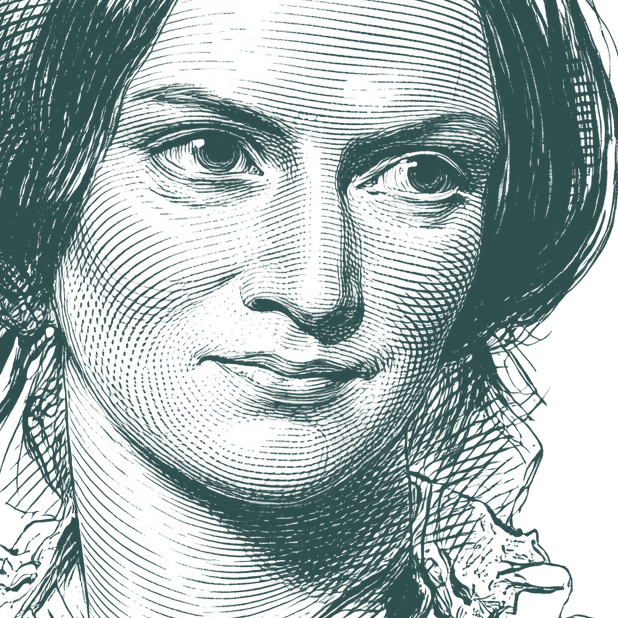
British novelist and poet (1816-1855)
Charlotte Brontë (21 April 1816 – 31 March 1855) was an English novelist, the eldest of the three Brontë sisters, who first published her work under the pseudonym Currer Bell.
Bio from: Wikiquote (CC BY-SA 4.0) · Portrait adapted from: Wikimedia Commons, George Richmond (Public domain / CC0)
From Wikidata (CC0)

Works in ChatGPT, Claude, or Any AI
Add semantic quote search to your AI assistant via MCP. One command setup.
"They spoke almost as loud as Feeling: and that clamoured wildly. "Oh, comply!" it said. "Think of his misery; think of his danger — look at his state when left alone; remember his headlong nature; consider the recklessness following on despair — soothe him; save him; love him; tell him you love him and will be his. Who in the world cares for you? or who will be injured by what you do?"
Still indomitable was the reply — "I care for myself. The more solitary, the more friendless, the more unsustained I am, the more I will respect myself. I will keep the law given by God; sanctioned by man. I will hold to the principles received by me when I was sane, and not mad — as I am now. Laws and principles are not for the times when there is no temptation: they are for such moments as this, when body and soul rise in mutiny against their rigour; stringent are they; inviolate they shall be. If at my individual convenience I might break them, what would be their worth? They have a worth — so I have always believed; and if I cannot believe it now, it is because I am quite insane — quite insane: with my veins running fire, and my heart beating faster than I can count its throbs. Preconceived opinions, foregone determinations, are all I have this hour to stand by: there I plant my foot.
She sang, as requested. There was much about love in the ballad: faithful love that refused to abandon its object; love that disaster could not shake; love that, in calamity, waxed fonder, in poverty clung closer. The words were set to a fine old air — in themselves they were simple and sweet: perhaps, when read, they wanted force; when well sung, they wanted nothing. Shirley sang them well: she breathed into the feeling, softness, she poured round the passion, force: her voice was fine that evening; its expression dramatic: she impressed all, and charmed one.
On leaving the instrument, she went to the fire, and sat down on a seat — semi-stool, semi-cushion: the ladies were round her — none of them spoke. The Misses Sympson and the Misses Nunnely looked upon her, as quiet poultry might look on an egret, an ibis, or any other strange fowl. What made her sing so? They never sang so. Was it proper to sing with such expression, with such originality — so unlike a school girl? Decidedly not: it was strange, it was unusual. What was strange must be wrong; what was unusual must be improper. Shirley was judged.
For a long time the fear of seeming singular scared me away; but by degrees, as people became accustomed to me and my habits, and to such shadows of peculiarity as were engrained in my nature - shades, certainly not striking enough to interest, and perhaps not prominent enough to offend, but born in and with me, and no more to be parted with than my identity - but slow degrees I became a frequenter of this straight narrow path.
Works in ChatGPT, Claude, or Any AI
Add semantic quote search to your AI assistant via MCP. One command setup.
"You are going, Jane?"
"I am going, sir."
"You are leaving me?"
"Yes."
"You will not come? You will not be my comforter, my rescuer? My deep love, my wild woe, my frantic prayer, are all nothing to you?"
What unutterable pathos was in his voice! How hard was it to reiterate firmly, "I am going!"
"Jane!"
"Mr. Rochester."
"Withdraw then, I consent; but remember, you leave me here in anguish. Go up to your own room, think over all I have said, and, Jane, cast a glance on my sufferings; think of me."
He turned away, he threw himself on his face on the sofa. "Oh, Jane! my hope, my love, my life!" broke in anguish from his lips. Then came a deep, strong sob.