Those of us who write and study history are accustomed to its approximations and ambiguities. This is why we do not take literally the tenth-hand reports of frightened and illiterate peasants who claim to have seen miracles or to have had encounters with messiahs and prophets and redeemers who were, like them, mere humans. And this is also why we will never submit to dictation from those who display a fanatical belief in certainty and revelation.
English American author and journalist (1949–2011)
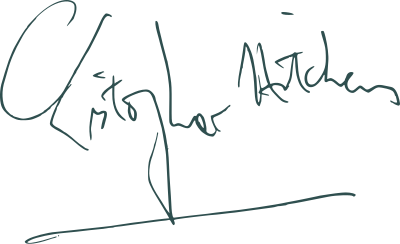
Christopher Eric Hitchens (13 April 1949 – 15 December 2011) was an-English-American journalist and writer. He contributed to the New Statesman, The Nation, The Atlantic, London Review of Books, The Times Literary Supplement, Slate, and Vanity Fair. Hitchens was the author, co-author, editor or co-editor of over 30 books, including five collections of essays, on a range of subjects, including politics, literature, and religion. A staple of talk shows and lecture circuits, his confrontational style of debate made him both a lauded and controversial figure and public intellectual.
Bio from: Wikiquote (CC BY-SA 4.0) · Portrait adapted from: Wikimedia Commons, ensceptico (CC BY)
Birth Name:
Christopher Eric Hitchens
Also Known As:
Hitch
From Wikidata (CC0)

Showing quotes in randomized order to avoid selection bias. Click Popular for most popular quotes.
Rushdie had written a book of nonfiction which offered critical but decided support to the Nicaraguan revolution. He had also been eloquent about the rights of the ever-relegated Palestinians. What more natural, when he was threatened with assassination by contract, than to jubilate about a terrorist-symp who had been caught in his own logic? I counted some ten newspaper and magazine columns from the Podhoretz school, all making this same point in the same words — demonstrating the impressive Zhdanovite discipline that is the special mark of the faction. All of them seemed to regard the affair as some sort of heavenly revenge for the sin of radical promiscuity; much as they have represented the AIDS crisis as a vengeance as on sixties morality. The ethical nullity of these positions never got beyond mere gloating, and will one day help to illustrate the essential distinction between irony and brutish sarcasm.
Enhance Your Quote Experience
Enjoy ad-free browsing, unlimited collections, and advanced search features with Premium.
Many religions now come before us with ingratiating smirks and outspread hands, like an unctuous merchant in a bazaar. They offer consolation and solidarity and uplift, competing as they do in a marketplace. But we have a right to remember how barbarically they behaved when they were strong and were making an offer that people could not refuse.
I think I have a very good idea why it is that anti-Semitism is so tenacious and so protean and so enduring. Christianity and Islam, theistic though they may claim to be, are both based on the fetishizing of human primates: Jesus in one case and Mohammed in the other. Neither of these figures can be called exactly historical but both have one thing in common even in their quasi-mythical dimension. Both of them were first encountered by the Jews. And the Jews, ravenous as they were for any sign of the long-sought Messiah, were not taken in by either of these two pretenders, or not in large numbers or not for long.
If you meet a devout Christian or a believing Muslim, you are meeting someone who would give everything he owned for a personal, face-to-face meeting with the blessed founder or prophet. But in the visage of the Jew, such ardent believers encounter the very figure who did have such a precious moment, and who spurned the opportunity and turned shrugging aside. Do you imagine for a microsecond that such a vile, churlish transgression will ever be forgiven? I myself certainly hope that it will not. The Jews have seen through Jesus and Mohammed. In retrospect, many of them have also seen through the mythical, primitive, and cruel figures of Abraham and Moses. Nearer to our own time, in the bitter combats over the work of Marx and Freud and Einstein, Jewish participants and protagonists have not been the least noticeable. May this always be the case, whenever any human primate sets up, or is set up by others, as a Messiah.
As for the woman styling herself Mother Teresa, I can attest that until I wrote my little pamphlet, she had been the recipient, the beneficiary, of a twenty-five year Niagra of one-hundred percent favorable publicity in every secular, Protestant, Jewish, and Catholic, or non-religious outlet of any kind at all in the media. Only by the grace of my intervention [laughter] could it not be said, when she died, that no one had ever said a single word against her; and that no one had ever pointed out that she had fawned on the Duvalier family in Haiti and said that they were the Lord's anointed and beloved of the poor.
George Bush made a mistake when he referred to the Saddam Hussein regime as 'evil.' Every liberal and leftist knows how to titter at such black-and-white moral absolutism. What the president should have done, in the unlikely event that he wanted the support of America's peace-mongers, was to describe a confrontation with Saddam as the 'lesser evil.' This is a term the Left can appreciate. Indeed, 'lesser evil' is part of the essential tactical rhetoric of today's Left, and has been deployed to excuse or overlook the sins of liberal Democrats, from President Clinton's bombing of Sudan to Madeleine Albright's veto of an international rescue for Rwanda when she was U.S. ambassador to the United Nations. Among those longing for nuance, moral relativism — the willingness to use the term evil, when combined with a willingness to make accommodations with it — is the smart thing: so much more sophisticated than 'cowboy' language.
PREMIUM FEATURE
Advanced Search Filters
Filter search results by source, date, and more with our premium search tools.
I’m quite convinced in my own mind that those who were arguing that [the need to intervene in Iraq] was a more immediate one than some believed - were I’m sure convinced that they were right on fact, I don’t think they were making it up. So as to lying, I don’t think it has been established that any lies were told.