Canadian-American economist and diplomat (1908–2006)
John Kenneth Galbraith (15 October 1908 – 29 April 2006) was a Canadian-American economist and author.
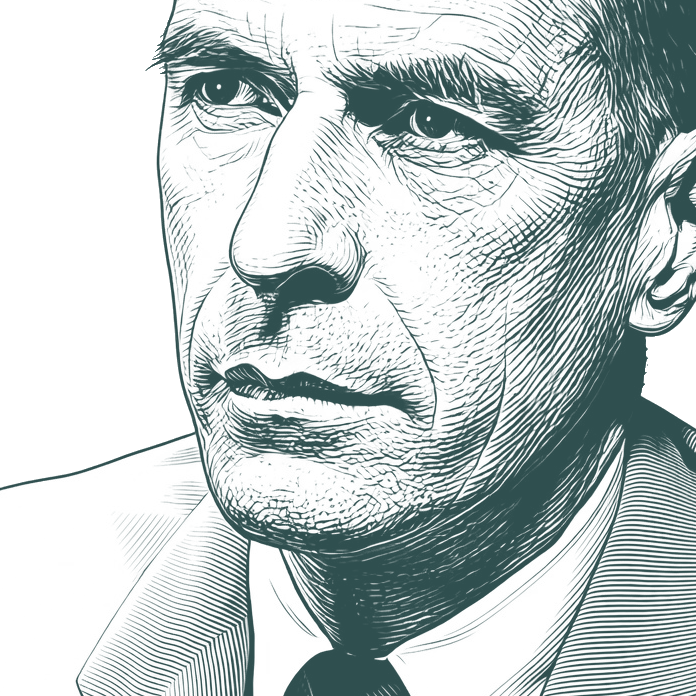
Bio from: Wikiquote (CC BY-SA 4.0) · Portrait adapted from: Wikimedia Commons, Published by Houghton Mifflin Company. Photographer is unknown. (Public domain / CC0)
From Wikidata (CC0)
Going back to the most ancient times, national well-being, the national prestige depended on territory. The more territory a country had, the more income revenue there was, the more people there were to be mobilized for arms strength. So we had an enormous sense of territorial conflict and territorial integrity, and that was unquestionably a part of the cause of war, coupled with the fact that there was a disposition in that direction by the landed class, a disposition to think of territorial acquisition and territorial defense and to think of the peasantry as a superior form of livestock which could be used for arms purposes.
During the last century and until 1907, the United States had panics, and that, unabashedly, is what they were called. But, by 1907, the language was becoming, like so much else, the servant of economic interest. To minimize the shock to confidence, businessmen and bankers had started to explain that any current economic setback was not really a panic, only a crisis. They were undeterred by the use of this term in a much more ominous context—that of the ultimate capitalist crisis—by Marx. By the 1920's, however, the word crisis had also acquired the fearsome connotation of the event it described. Accordingly, men offered reassurance by explaining that it was not a crisis, only a depression. A very soft word. Then the Great Depression associated the most frightful of economic misfortunes with that term, and economic semanticists now explained that no depression was in prospect, at most only a recession. In the 1950s, when there was a modest setback, economists and public officials were united in denying that it was a recession—only a sidewise movement or a rolling readjustment. Mr. Herbert Stein, the amiable man whose difficult honor it was to serve as the economic voice of Richard Nixon, would have referred to the as a growth correction.
No feature of American—to some extent of Anglo-Saxon—politics is so certain as the tendency of politicians to become first the captives, then the agents, of their opposition. ...In the 1960s, liberal Democrats... urged peace and international amity but continued the Cold War and plunged the country into Vietnam. ...partly because they feared being called appeasers and crypto-Communists by the right. Richard Nixon, having impeccable credentials as a Cold Warrior, moved towards peace or accommodation with Moscow and Peking and withdrew... from Vietnam. Thus on foreign policy he outflanked his liberal opposition. When Professor Milton Friedman proposed a guaranteed income for the poor, it was considered (quite correctly) an act of creative imagination. When a Republican administration proposed it to Congress, it was a mark of conservative statemanship. When George McGovern, running for President, advanced a close variant... it was condemned by conservatives as the dream of a fiscal maniac. As known and stalwart defenders of the dollar, the Republicans were able, in the early 1970s, to devalue it... twice. For anyone suspected of a more flexible attitude towards the integrity of the dollar, such action would have been exceedingly perilous.
I've long believed alas, that in highly organized industrial societies, capitalist or socialist, the stronger tendency is to converge — that if steel or automobiles are wanted and must be made on a large scale, the process will stamp its imprint on the society, whether that me be Magnitogorsk or Gary, Indiana.
This is what economics now does. It tells the young and susceptible (and also the old and vulnerable) that economic life has no content of power and politics because the firm is safely subordinate to the market and the state and for this reason it is safely at the command of the consumer and citizen. Such an economics is not neutral. It is the influential and invaluable ally of those whose exercise of power depends on an acquiescent public. If the state is the executive committee of the great corporation and the planning system, it is partly because neoclassical economics is its instrument for neutralizing the suspicion that this is so.