Canadian-American economist and diplomat (1908–2006)
John Kenneth Galbraith (15 October 1908 – 29 April 2006) was a Canadian-American economist and author.
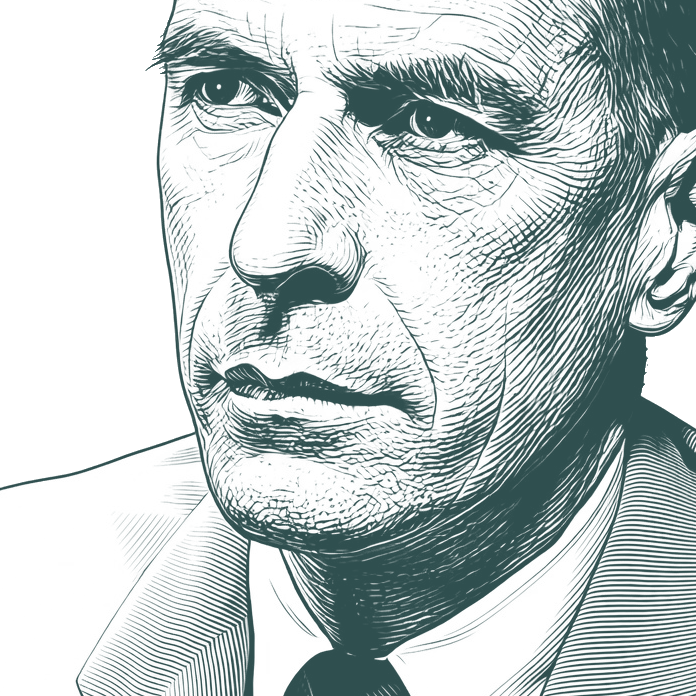
Bio from: Wikiquote (CC BY-SA 4.0) · Portrait adapted from: Wikimedia Commons, Published by Houghton Mifflin Company. Photographer is unknown. (Public domain / CC0)
From Wikidata (CC0)
No feature of American—to some extent of Anglo-Saxon—politics is so certain as the tendency of politicians to become first the captives, then the agents, of their opposition. ...In the 1960s, liberal Democrats... urged peace and international amity but continued the Cold War and plunged the country into Vietnam. ...partly because they feared being called appeasers and crypto-Communists by the right. Richard Nixon, having impeccable credentials as a Cold Warrior, moved towards peace or accommodation with Moscow and Peking and withdrew... from Vietnam. Thus on foreign policy he outflanked his liberal opposition. When Professor Milton Friedman proposed a guaranteed income for the poor, it was considered (quite correctly) an act of creative imagination. When a Republican administration proposed it to Congress, it was a mark of conservative statemanship. When George McGovern, running for President, advanced a close variant... it was condemned by conservatives as the dream of a fiscal maniac. As known and stalwart defenders of the dollar, the Republicans were able, in the early 1970s, to devalue it... twice. For anyone suspected of a more flexible attitude towards the integrity of the dollar, such action would have been exceedingly perilous.
The decisive weakness in neoclassical and neo-Keynesian economics is not the error in the assumptions by which it elides the problem of power. The capacity for erroneous belief is very great, especially where it coincides with convenience. Rather, in eliding power — in making economics a nonpolitical subject — neoclassical theory destroys its relation to the real world. In that world, power is decisive in what happens. And the problems of that world are increasing both in number and in the depth of their social affliction. In consequence, neoclassical and neo-Keynesian economics is relegating its players to the social sidelines where they either call no plays or use the wrong ones. To change the metaphor, they manipulate levers to which no machinery is attached.
But now, as throughout history, financial capacity and political perspicacity are inversely correlated. Long run salvation by men of business has never been highly regarded if it means disturbance of orderly life and convenience in the present. So inaction will be advocated in the present even though it means deep trouble in the future. Here, at least equally with communism, lies the threat to capitalism. It is what causes men who know that things are going quite wrong to say that things are fundamentally sound.
Try QuoteGPT
Chat naturally about what you need. Each answer links back to real quotes with citations.