"You are hereby warned that any movement on your part not explicitly endorsed by verbal authorization on my part may pose a direct physical risk to you, as well as consequential psychological and possibly, depending on your personal belief system, spiritual risks ensuing from your personal reaction to said physical risk. Any movement on your part constitutes an implicit and irrevocable acceptance of such risk," the first MetaCop says. There is a little speaker on his belt, simultaneously translating all of this into Spanish and Japanese.
"Or as we used to say," the other MetaCop says, "freeze, sucker!"
"Under provisions of The Mews at Windsor Heights Code, we are authorized to enforce law, national security concerns, and societal harmony on said territory also. A treaty between The Mews at Windsor Heights and White Columns authorizes us to place you in temporary custody until your status as an Investigatory Focus has been resolved."
"Your ass is busted," the second MetaCop says.
"As your demeanor has been nonaggressive and you carry no visible weapons, we are not authorized to employ heroic measures to ensure your cooperation," the first MetaCop says.
"You stay cool and we'll stay cool," the second MetaCop says.
"However, we are equipped with devices, including but not limited to projectile weapons, which, if used, may pose an extreme and immediate threat to your health and well-being."
"Make one funny move and we'll blow your head off," the second MetaCop says.
American science fiction writer (born 1959)
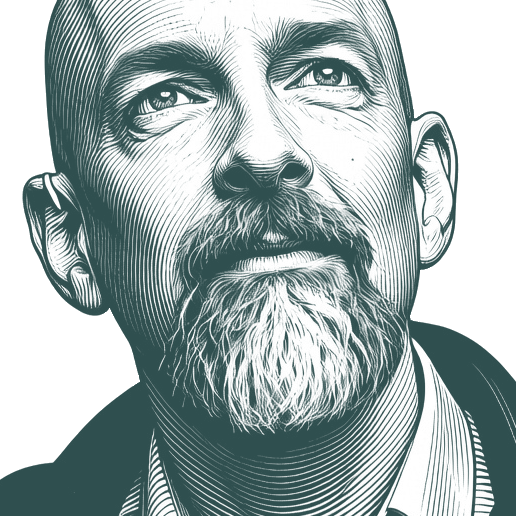
Neal Town Stephenson (born 31 October 1959) is an American writer, known primarily for his science fiction works in the postcyberpunk and chemical generation genres with a penchant for explorations of society, mathematics, currency, and the history of science.
Bio from: Wikiquote (CC BY-SA 4.0) · Portrait adapted from: Wikimedia Commons, Christopher Michel (CC BY-SA)
Pen Names:
Stephen Bury
Birth Name:
Neal Town Stephenson
From Wikidata (CC0)
"The biggest machines, in those days, were already pushing the limits of what could be constructed on Arbre with reasonable amounts of money."
"I hadn't known that," I said. "I always tend to assume there's an infinite amount of money out there."
"There might as well be," Arsibalt said, "but most of it gets spent on pornography, sugar water, and bombs. There is only so much that can be scraped together for particle accelerators."
And Türing answered another,” Rudy said.
“Who’s that?”
“It’s me,” Alan said. “But Rudy’s joking. ‘Turing’ doesn’t really have an umlaut in it.”
“He’s going to have an umlaut in him later tonight,” Rudy said, looking at Alan in a way that, in retrospect, years later, Lawrence would understand to have been smoldering.
Works in ChatGPT, Claude, or Any AI
Add semantic quote search to your AI assistant via MCP. One command setup.
Unix is not so much a product as it is a painstakingly compiled oral history of the hacker subculture. It is our Gilgamesh epic: a living body of narrative that many people know by heart, and tell over and over again — making their own personal embellishments whenever it strikes their fancy. The bad embellishments are shouted down, the good ones picked up by others, polished, improved, and, over time, incorporated into the story. […] Thus Unix has slowly accreted around a simple kernel and acquired a kind of complexity and asymmetry about it that is organic, like the roots of a tree, or the branchings of a coronary artery. Understanding it is more like anatomy than physics.
Other people - store clerks, burger flippers, software engineers, the whole vocabulary of meaningless jobs that make up Life in America - other people just rely on plain old competition. Better flip your burgers or debug your subroutines faster than your high school classmate two blocks down the strip is flipping or debugging, because we're in competition with those guys, and people notice these things.
What a fucking rat race that is.
This was governed entirely by Newtonian mechanics. Each piece of the moon attracted every other piece more or less strongly depending on its mass and its distance. It could be simulated on a computer quite easily. The whole rubble cloud was gravitationally bound. Any shrapnel fast enough to escape had done so already. The rest was drifting around in a loose huddle of rocks. Sometimes they banged into one another. Eventually they would stick together and the moon would begin to re-form.
I would say that the ability of people to agree on matters of fact not immediately visible — states of affairs removed from them in space and time — ramped up from a baseline of approximately zero to a pretty high level around the time of the scientific revolution and all that, and stayed there and became more globally distributed up through the Cronkite era, and then dropped to zero incredibly quickly when the Internet came along.