"CHAPTER XXVI. — A new Prince in a City or Province of which he has taken Possession, ought to make Everything new. Whosoever becomes prince of a city or State, more especially if his position be so insecure that he cannot resort to constitutional government either in the form of a republic or a monarchy, will find that the best way to preserve his princedom is to renew the whole institutions of that State; that is to say, to create new magistracies with new names, confer new powers, and employ new men, and like David when he became king, exalt the humble and depress the great, "filling the hungry with good things, and sending the rich empty away." Moreover, he must pull down existing towns and rebuild them, removing their inhabitants from one place to another; and, in short, leave nothing in the country as he found it; so that there shall be neither rank, nor condition, nor honour, nor wealth which its possessor can refer to any but to him. And he must take example from Philip of Macedon, the father of Alexander, who by means such as these, from being a petty prince became monarch of all Greece; and of whom it was written that he shifted men from province to province as a shepherd moves his flocks from one pasture to another. These indeed are most cruel expedients, contrary not merely to every Christian, but to every civilized rule of conduct, and such as every man should shun, choosing rather to lead a private life than to be a king on terms so hurtful to mankind. But he who will not keep to the fair path of virtue, must to maintain himself enter this path of evil. Men, however, not knowing how to be wholly good or wholly bad, choose for themselves certain middle ways, which of all others are the most pernicious, as shall be shown by an instance in the following Chapter."
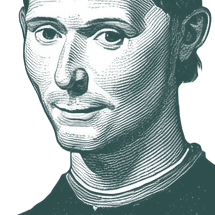
Italian diplomat and political and military theorist (1469–1527)
Niccolò Machiavelli (3 May 1469 – 21 June 1527) was an Italian political philosopher, historian, musician, poet, and romantic comedic playwright. Machiavelli was also a key figure in realist political theory, crucial to European statecraft during the Renaissance.
Bio from: Wikiquote (CC BY-SA 4.0) · Portrait adapted from: Wikimedia Commons, Santi di Tito (Public domain / CC0)
Native Name:
Niccolò di Bernardo dei Machiavelli
Alternative Names:
Nicolas Machiavel
•
Machiavel
•
Niccolo di Bernardo dei Machiavelli
•
Niccolo Machiavelli
•
Nicolò Machiavelli
•
Nicolo Machiavelli
•
Machiavelli
•
N. Machiavelli
From Wikidata (CC0)

Showing quotes in randomized order to avoid selection bias. Click Popular for most popular quotes.
At nightfall I return home and enter my study. There on the threshold I remove my dirty, mud-spattered clothes, slip on my regal and courtly robes, and thus fittingly attired, I enter the ancient courts of bygone men where, having received a friendly welcome, I feed on the food that is mine alone and that I was born for. I am not ashamed to speak with them and inquire into the reasons for their actions; and they answer me in kindly fashion. And so for four hours I feel no annoyance; I forget all troubles; poverty hold no fears, and death loses its terrors. I become entirely one of them.
PREMIUM FEATURE
Advanced Search Filters
Filter search results by source, date, and more with our premium search tools.
When evening has come, I return to my house and go into my study. At the door I take off my clothes of the day, covered with mud and mire, and I put on my regal and courtly garments; and decently reclothed, I enter the ancient courts of ancient men, where, received by them lovingly, I feed on the food that alone is mine and that I was born for. There I am not ashamed to speak with them and to ask them the reason for their actions; and they in their humanity reply to me. And for the space of four hours I feel no boredom, I forget every pain, I do not fear poverty, death does not frighten me. I deliver myself entirely to them.
But confining myself more to the particular, I say that a prince may be seen happy to-day and ruined to-morrow without having shown any change of disposition or character. This, I believe, arises firstly from causes that have already been discussed at length, namely, that the prince who relies entirely upon fortune is lost when it changes. I believe also that he will be successful who directs his actions according to the spirit of the times, and that he whose actions do not accord with the times will not be successful. Because men are seen, in affairs that lead to the end which every man has before him, namely, glory and riches, to get there by various methods; one with caution, another with haste; one by force, another by skill; one by patience, another by its opposite; and each one succeeds in reaching the goal by a different method. One can also see of two cautious men the one attain his end, the other fail; and similarly, two men by different observances are equally successful, the one being cautious, the other impetuous; all this arises from nothing else than whether or not they conform in their methods to the spirit of the times. This follows from what I have said, that two men working differently bring about the same effect, and of two working similarly, one attains his object and the other does not.
The first opinion which one forms of a prince, and of his understanding, is by observing the men he has around him; and when they are capable and faithful he may always be considered wise, because he has known how to recognize the capable and to keep them faithful. But when they are otherwise one cannot form a good opinion of him, for the prime error which he made was in choosing them.
I say, then, that hereditary States, accustomed to the family of their Prince, are maintained with far less difficulty than new States, since all that is required is that the Prince shall not depart from the usages of his ancestors, trusting for the rest to deal with events as they arise. So that if an hereditary Prince be of average address, he will always maintain himself in his Princedom, unless deprived of it by some extraordinary and irresistible force; and even if so deprived will recover it, should any, even the least, mishap overtake the usurper. We have in Italy an example of this in the Duke of Ferrara, who never could have withstood the attacks of the Venetians in 1484, nor those of Pope Julius in 1510, had not his authority in that State been consolidated by time. For since a Prince by birth has fewer occasions and less need to give offence, he ought to be better loved, and will naturally be popular with his subjects unless outrageous vices make him odious. Moreover, the very antiquity and continuance of his rule will efface the memories and causes which lead to innovation. For one change always leaves a dovetail into which another will fit.
For that reason, let a prince have the credit of conquering and holding his state, the means will always be considered honest, and he will be praised by everybody because the vulgar are always taken by what a thing seems to be and by what comes of it; and in the world there are only the vulgar, for the few find a place there only when the many have no ground to rest on.