president of the United States from 1801 to 1809
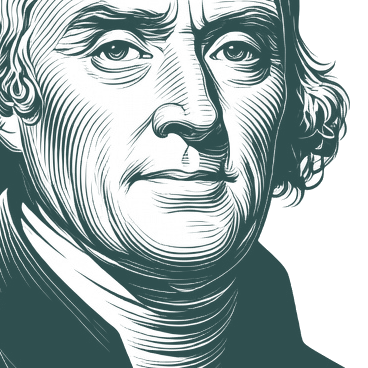
Thomas Jefferson (13 April 1743 – 4 July 1826) was author of the Declaration of Independence (1776) and the Virginia Statute for Religious Freedom (1777), founder of the University of Virginia (1819), the third president of the United States (1801–1809), a political philosopher, editor of Jefferson's Bible (1819), and one of the most influential founders of the United States.
Bio from: Wikiquote (CC BY-SA 4.0) · Portrait adapted from: Wikimedia Commons, Rembrandt Peale (Public domain / CC0)
From Wikidata (CC0)

Treasury notes of small as well as high denomination, bottomed on a tax which would redeem them in ten years, would place at our disposal the whole circulating medium of the United States... The public... ought never more to permit its being filched from them by private speculators and disorganizers of the circulation.
On similar ground it may be proved that no society can make a perpetual constitution, or even a perpetual law. The earth belongs always to the living generation. They may manage it then, & what proceeds from it, as they please, during their usufruct. They are masters too of their own persons, & consequently may govern them as they please. But persons & property make the sum of the objects of government. The constitution and the laws of their predecessors extinguished then in their natural course, with those who gave them being. This could preserve that being till it ceased to be itself, & no longer. Every constitution then, & every law, naturally expires at the end of 19 years. If it be enforced longer, it is an act of force, & not of right. It may be said that the succeeding generation exercising in fact the power of repeal, this leaves them as free as if the constitution or law had been expressly limited to 19 years only.
Enhance Your Quote Experience
Enjoy ad-free browsing, unlimited collections, and advanced search features with Premium.
All, too, will bear in mind this sacred principle, that though the will of the majority is in all cases to prevail, that will to be rightful must be reasonable; that the minority possess their equal rights, which equal law must protect, and to violate would be oppression. Let us, then, fellow-citizens, unite with one heart and one mind. Let us restore to social intercourse that harmony and affection without which liberty and even life itself are but dreary things.
We hold these truths to be self-evident, that all men are created equal, that they are endowed by their Creator with certain unalienable Rights, that among these are Life, Liberty, and the pursuit of Happiness.—That to secure these rights, Governments are instituted among Men, deriving their just powers from the consent of the governed, That whenever any Form of Government becomes destructive of these ends, it is the Right of the People to alter or to abolish it, and to institute new Government, laying its foundation on such principles and organizing its powers in such form, as to them shall seem most likely to effect their Safety and Happiness.
Considering the general tendency to multiply offices and dependencies and to increase expense to the ultimate term of burden which the citizen can bear, it behooves us to avail ourselves of every occasion which presents itself for taking off the surcharge; that it never may be seen here that, after leaving to labor the smallest portion of its earnings on which it can subsist, Government shall itself consume the whole residue of what it was instituted to guard.
An hereditary chief, strictly limited, the right of war vested in the legislative body, a rigid economy of the public contributions, and absolute interdiction of all useless expenses, will go far towards keeping the government honest and unoppressive. But the only security of all is in a free press. The force of public opinion cannot be resisted, when permitted freely to be expressed. The agitation it produces must be submitted to. It is necessary, to keep the waters pure.