American Founding Father, philosopher, and political activist (1737–1809)
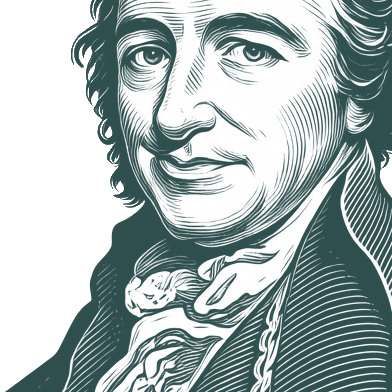
Thomas Paine (February 9, 1737 [O.S. January 29, 1736] – 8 June 1809) was a British-American political writer, theorist, and activist who had a great influence on the thoughts and ideas which led to the American Revolution and the United States Declaration of Independence. He wrote three of the most influential and controversial works of the 18th Century: Common Sense, Rights of Man, and The Age of Reason. His ideas reflected Enlightenment-era ideals of transnational human rights.
Bio from: Wikiquote (CC BY-SA 4.0) · Portrait adapted from: Wikimedia Commons, Auguste Millière / After George Romney / After William Sharp (Public domain / CC0)

Every government that does not act on the principle of a Republic, or in other words, that does not make the res-publica its whole and sole object, is not a good government. Republican government is no other than government established and conducted for the interest of the public, as well individually as collectively. It is not necessarily connected with any particular form, but it most naturally associates with the representative form, as being best calculated to secure the end for which a nation is at the expense of supporting it.
Works in ChatGPT, Claude, or Any AI
Add semantic quote search to your AI assistant via MCP. One command setup.
Of all the systems of religion that ever were invented, there is none more derogatory to the Almighty, more unedifying to man, more repugnant to reason, and more contradictory in itself than this thing called Christianity. Too absurd for belief, too impossible to convince, and too inconsistent for practice, it renders the heart torpid, or produces only atheists and fanatics. As an engine of power it serves the purpose of despotism; and as a means of wealth, the avarice of priests; but so far as respects the good of man in general, it leads to nothing here or hereafter.
Ceea ce acum poarta numele de filosofie naturala, cuprinzand intregul cerc al stiintei, unde astronomia ocupa pozitia principala, reprezinta studiul lucrarii lui Dumnezeu si al puterii si intelepciunii lui Dumnezeu din lucrarea Sa, aceasta fiind adevarata teologie. [...] Cat despre teologia studiata acum in locul acesteia, este vorba despre studiul opiniilor si inchipuirilor omenesti despre Dumnezeu.
The continually progressive change to which the meaning of words is subject, the want of a universal language which renders translation necessary, the errors to which translations are again subject, the mistakes of copyists and printers, together with the possibility of willful alteration, are of themselves evidences that human language, whether in speech or in print, cannot be the vehicle of the Word of God.-The Word of God exists in something else.
Loving, of enemies is another dogma of feigned morality, and has besides no meaning. It is incumbent on man, as a moralist, that he does not revenge an injury; and it is equally as good in a political sense, for there is no end to retaliation; each retaliates on the other, and calls it justice: but to love in proportion to the injury, if it could be done, would be to offer a premium for a crime. Besides, the word enemies is too vague and general to be used in a moral maxim, which ought always to be clear and defined, like a proverb. If a man be the enemy of another from mistake and prejudice, as in the case of religious opinions, and sometimes in politics, that man is different to an enemy at heart with a criminal intention; and it is incumbent upon us, and it contributes also to our own tranquillity, that we put the best construction upon a thing that it will bear. But even this erroneous motive in him makes no motive for love on the other part; and to say that we can love voluntarily, and without a motive, is morally and physically impossible.
Morality is injured by prescribing to it duties that, in the first place, are impossible to be performed, and if they could be would be productive of evil; or, as before said, be premiums for crime. The maxim of doing as we would be done unto does not include this strange doctrine of loving enemies; for no man expects to be loved himself for his crime or for his enmity.
Those who preach this doctrine of loving their enemies, are in general the greatest persecutors, and they act consistently by so doing; for the doctrine is hypocritical, and it is natural that hypocrisy should act the reverse of what it preaches. For my own part, I disown the doctrine, and consider it as a feigned or fabulous morality; yet the man does not exist that can say I have persecuted him, or any man, or any set of men, either in the American Revolution, or in the French Revolution; or that I have, in any case, returned evil for evil.
But there is another and greater distinction for which no truly natural or religious reason can be assigned, and that is the distinction of men into kings and subjects. Male and female are the distinctions of nature, good and band, the distinctions of heaven; but how a race of men came into the world so exalted above the rest, and distinguished like some new species, is worth inquiring into, and whether they are the means of happiness or of misery to mankind.