French writer, historian and philosopher (1694–1778)
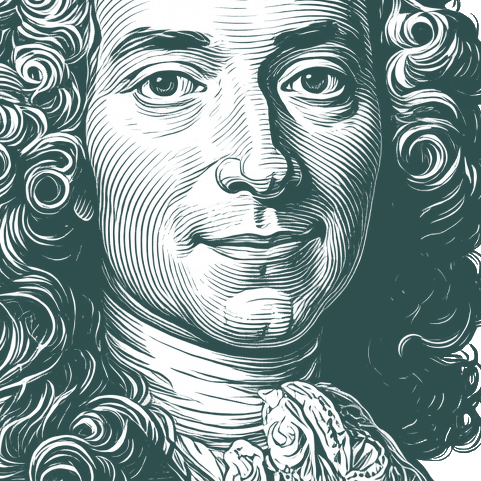
François-Marie Arouet (21 November 169430 May 1778), known by his nom de plume Voltaire, was a French Enlightenment writer, philosopher (philosophe), satirist, and historian. Famous for his wit and his criticism of Christianity (especially of the Roman Catholic Church) and of slavery, Voltaire was an advocate of freedom of speech, freedom of religion, and separation of church and state. Voltaire was a versatile and prolific writer, producing works in almost every literary form, including plays, poems, novels, essays, histories, and even scientific expositions. He wrote more than 20,000 letters and 2,000 books and pamphlets. Voltaire was one of the first authors to become renowned and commercially successful internationally. He was an outspoken advocate of civil liberties and was at constant risk from the strict censorship laws of the Catholic French monarchy. His polemics witheringly satirized intolerance and religious dogma, as well as the French institutions of his day. His best-known work and magnum opus, Candide, is a novella that comments on, criticizes, and ridicules many events, thinkers and philosophies of his time, most notably Gottfried Leibniz and his belief that our world is of necessity the "best of all possible worlds".
Bio from: Wikipedia (CC BY-SA 4.0) · Portrait adapted from: Wikimedia Commons, Nicolas de Largillière (Public domain / CC0)
From Wikidata (CC0)

Works in ChatGPT, Claude, or Any AI
Add semantic quote search to your AI assistant via MCP. One command setup.
Mais, monsieur, en étant persuadés par la foi, des choses qui paraissent absurdes à notre intelligence, c'est-à-dire, en croyant ce que nous ne croyons pas, gardons-nous de faire ce sacrifice de notre raison dans la conduite de la vie. Il y a eu des gens qui ont dit autrefois: Vous croyez des choses incompréhensibles, contradictoires, impossibles, parce que nous vous l'avons ordonné; faites donc des choses injustes parce que nous vous l'ordonnons. Ces gens-là raisonnaient à merveille. Certainement qui est en droit de vous rendre absurde est en droit de vous rendre injuste. Si vous n'opposez point aux ordres de croire l'impossible l'intelligence que Dieu a mise dans votre esprit, vous ne devez point opposer aux ordres de malfaire la justice que Dieu a mise dans votre coeur. Une faculté de votre âme étant une fois tyrannisée, toutes les autres facultés doivent l'être également. Et c'est là ce qui a produit tous les crimes religieux dont la terre a été inondée.
C'est une grande question parmi eux s'ils [les africains] sont descendus des singes ou si les singes sont venus d'eux. Nos sages ont dit que l'homme est l'image de Dieu: voilà une plaisante image de l'Être éternel qu'un nez noir épaté, avec peu ou point d'intelligence! Un temps viendra, sans doute, où ces animaux sauront bien cultiver la terre, l'embellir par des maisons et par des jardins, et connaître la route des astres il faut du temps pour tout.
Works in ChatGPT, Claude, or Any AI
Add semantic quote search to your AI assistant via MCP. One command setup.
Try QuoteGPT
Chat naturally about what you need. Each answer links back to real quotes with citations.