- Report an issue with this quote
Help improve quote accuracy
- Log in to report
- Create an account
American novelist (born 1937)
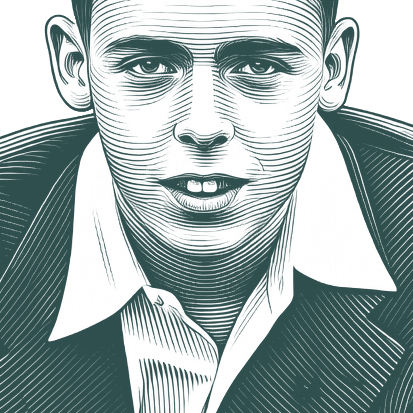
Thomas Ruggles Pynchon, Jr. (born 8 May 1937) is an American writer based in New York City, known for his dense and complex works of fiction.
Bio from: Wikiquote (CC BY-SA 4.0) · Portrait adapted from: Wikimedia Commons, Photo presumably taken by "Mr. DiLillo", who was identified as staff photographer of The Oysterette (Mead 1989, p. 170). (Public domain / CC0)
Alternative Names:
Thomas Ruggles Pynchon, Jr.
•
Thomas Ruggles Pynchon
From Wikidata (CC0)

Showing quotes in randomized order to avoid selection bias. Click Popular for most popular quotes.
Works in ChatGPT, Claude, or Any AI
Add semantic quote search to your AI assistant via MCP. One command setup.
Holy shit.” This is the kind of sunset you hardly see any more, a 19th-century wilderness sunset, a few of which got set down, approximated, on canvas, landscapes of the American West by artists nobody ever heard of, when the land was still free and the eye innocent, and the presence of the Creator much more direct. Here it thunders now over the Mediterranean, high and lonely, this anachronism in primal red, in yellow purer that can be found anywhere today, a purity begging to be polluted…of course Empire took its way westward, what other way was there but into those virgin sunsets to penetrate and to foul?
"Young Tchitcherine was the one who brought up political narcotics. Opiates of the people.
Wimpe smiled back. An old, old smile to chill even the living fire in Earth’s core. "Marxist dialectics? That’s not an opiate, eh?"
"It’s the antidote."
"No." It can go either way. The dope salesman may know everything that’s ever going to happen to Tchitcherine, and decide it’s no use — or, out of the moment’s velleity, lay it right out for the young fool.
"The basic problem," he proposes, "has always been getting other people to die for you. What’s worth enough for a man to give up his life? That’s where religion had the edge, for centuries. Religion was always about death. It was used not as an opiate so much as a technique — it got people to die for one particular set of beliefs about death. Perverse, natürlich, but who are you to judge? It was a good pitch while it worked. But ever since it became impossible to die for death, we have had a secular version — yours. Die to help History grow to its predestined shape. Die knowing your act will bring will bring a good end a bit closer. Revolutionary suicide, fine. But look: if History’s changes are inevitable, why not not die? Vaslav? If it’s going to happen anyway, what does it matter?"
"But you haven’t ever had the choice to make, have you."
"If I ever did, you can be sure — "
"You don’t know. Not till you’re there, Wimpe. You can’t say."
"That doesn’t sound very dialectical."
"I don’t know what it is."
"Then, right up to the point of decision," Wimpe curious but careful, "a man could still be perfectly pure . . ."
"He could be anything. I don’t care. But he’s only real at the points of decision. The time between doesn’t matter."
"Real to a Marxist."
"No. Real to himself."
Wimpe looks doubtful.
"I've been there. You haven't.
"And one cried wee, wee, wee, all the way — " Jessica breaking down in a giggle as he reaches for the spot along her sweatered flank he knows she can't bear to be tickled in. She hunches, squirming, out of the way as he rolls past, bouncing off the back of the sofa but making a nice recovery, and by now she's ticklish all over, he can grab an ankle, elbow — But a rocket has suddenly struck. A terrific blast quite close beyond the village: the entire fabric of the air, the time, is changed — the casement window blown inward, rebounding with a wood squeak to slam again as all the house still shudders.
Their hearts pound. Eardrums brushed taut by the overpressure ring in pain. The invisible train rushes away close over the rooftop....
They sit still as the painted dogs now, silent, oddly unable to touch. Death has come in the pantry door: stands watching them, iron and patient, with a look that says try to tickle me.
In the eighteenth century it was often convenient to regard man as a clockwork automaton. In the nineteenth century, with Newtonian physics pretty well assimilated and a lot of work in thermodynamics going on, man was looked on as a heat engine, about 40 per cent efficient. Now in the twentieth century, with nuclear and subatomic physics a going thing, man had become something which absorbs X-rays, gamma rays and neutrons.
But on the way home tonight, you wish you'd picked him up, held him a bit. Just held him, very close to your heart, his cheek by the hollow of your shoulder, full of sleep. As it it were you who could, somehow, save him. For the moment not caring who you're supposed to be registered as. For the moment, anyway, no longer who the Caesars say you are.
Have you ever fall'n into one of those Cometary Dazes, with the way the Object grows brighter and brighter each night? These Apparitions in the Sky, we never observe them but in Motion, — gone in seconds, and if they return, we do not see them. Once safely a part of the Night Sky, they may hang there at their Pleasure, performing whatever their Work corresponds to shifting jibs and stay-sails, keeping perfectly upon Station, mimicking any faint, unnam'd Star you please. Do they watch us? Are they visits from the past, from an Age of Faith, when Miracles still literally happen'd?