American poet, essayist and journalist (1819–1892)
Walt Whitman (May 31, 1819 – March 26, 1892) was an American journalist and poet, most famous for his lifelong work on his book Leaves of Grass.
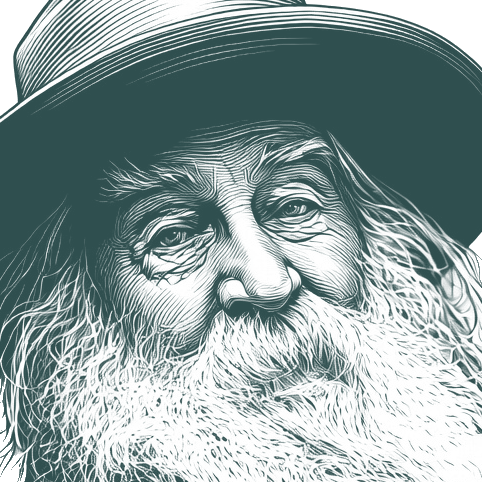
Bio from: Wikiquote (CC BY-SA 4.0) · Portrait adapted from: Wikimedia Commons, George Collins Cox / Adam Cuerden (Public domain / CC0)
From Wikidata (CC0)

Out of the rolling ocean the crowd came a drop gently to me,
Whispering I love you, before long I die,
I have travel'd a long way merely to look on you to touch you,
For I could not die till I once look'd on you,
For I fear'd I might afterward lose you.
Now we have met, we have look'd, we are safe,
Return in peace to the ocean my love,
I too am part of that ocean my love, we are not so much separated,
Behold the great rondure, the cohesion of all, how perfect!
But as for me, for you, the irresistible sea is to separate us,
As for an hour carrying us diverse, yet cannot carry us diverse forever;
Be not impatient — a little space — know you I salute the air, the
ocean and the land,
Every day at sundown for your dear sake my love.
A noiseless patient spider,
I mark'd where on a little promontory it stood isolated,
Mark'd how to explore the vacant vast surrounding,
It launch'd forth filament, filament, filament, out of itself,
Ever unreeling them, ever tirelessly speeding them.
And you O my soul where you stand,
Surrounded, detached, in measureless oceans of space,
Ceaselessly musing, venturing, throwing, seeking the spheres to connect them,
Till the bridge you will need be form'd, till the ductile anchor hold,
Till the gossamer thread you fling catch somewhere, O my soul.
from the pulling and hauling stands what I am, Stands amused, complacent, compassionating, idle, unitary, Looks down, is erect, or bends an arm on an impalpable certain rest, Looking with side-curved head curious what will come next, Both in and out of the game and watching and wondering at it. Backward I see in my own days where I sweated through fog with linguists and contenders, I have no mockings or arguments, I witness and wait.
Song of myself
Now I will do nothing but listen,
To accrue what I hear into this song, to let sounds contribute toward it.
I hear bravuras of birds, bustle of growing wheat, gossip of flames,
clack of sticks cooking my meals,
I hear the sound I love, the sound of the human voice,
I hear all sounds running together, combined, fused or following,
Sounds of the city and sounds out of the city, sounds of the day and night,
Talkative young ones to those that like them, the loud laugh of
work-people at their meals,
The angry base of disjointed friendship, the faint tones of the sick,
The judge with hands tight to the desk, his pallid lips pronouncing
a death-sentence,
The heave'e'yo of stevedores unlading ships by the wharves, the
refrain of the anchor-lifters,
The ring of alarm-bells, the cry of fire, the whirr of swift-streaking
engines and hose-carts with premonitory tinkles and color'd lights,
The steam-whistle, the solid roll of the train of approaching cars,
The slow march play'd at the head of the association marching two and two,
(They go to guard some corpse, the flag-tops are draped with black muslin.)
I hear the violoncello, ('tis the young man's heart's complaint,)
I hear the key'd cornet, it glides quickly in through my ears,
It shakes mad-sweet pangs through my belly and breast.
I hear the chorus, it is a grand opera,
Ah this indeed is music — this suits me.
Political democracy, as it exists and practically works in America, with all its threatening evils, supplies a training-school for making first-class men. It is life's gymnasium, not of good only, but of all. We try often, though we fall back often. A brave delight, fit for freedom's athletes, fills these arenas, and fully satisfies, out of the action in them, irrespective of success.