Long ago, Sir Isaac Newton gave us three laws of motion, which were the work of genius. But Sir Isaac's talents didn't extend to investing: He lost a bundle in the South Sea Bubble, explaining later, "I can calculate the movement of the stars, but not the madness of men." If he had not been traumatized by this loss, Sir Isaac might well have gone on to discover the Fourth Law of Motion: For investors as a whole, returns decrease as motion increases.
American investor, entrepreneur and businessman
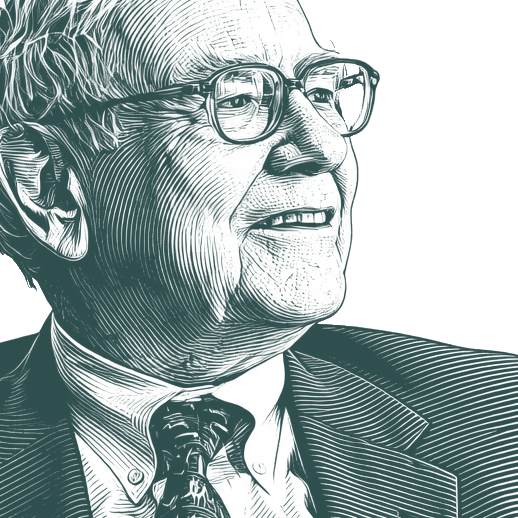
Warren Edward Buffett (born 30 August 1930) is an American business magnate, investor, and philanthropist. He is currently the chairman and CEO of Berkshire Hathaway. He is one of the most successful investors in the world and has a net worth of over $113 billion as of June 2022, making him the world's fifth-wealthiest person.
Bio from: Wikiquote (CC BY-SA 4.0) · Portrait adapted from: Wikimedia Commons, Mark Hirschey (CC BY-SA)
Also Known As:
The Oracle of Omaha
Alternative Names:
Warren Edward Buffett
From Wikidata (CC0)

Showing quotes in randomized order to avoid selection bias. Click Popular for most popular quotes.
But being short something where your loss is unlimited is quite different than being long something that you’ve already paid for. And it’s tempting. You see way more stocks that are dramatically overvalued in your career than you will see stocks that are dramatically undervalued. I mean there — it’s the nature of securities markets to occasionally promote various things to the sky, so that securities will frequently sell for 5 or 10 times what they’re worth, and they will very, very seldom sell for 20 percent or 10 percent of what they’re worth. So, therefore, you see these much greater discrepancies between price and value on the overvaluation side. So you might think it’s easier to make money on short selling. And all I can say is, it hasn’t been for me. I don’t think it’s been for Charlie. It is a very, very tough business because of the fact that you face unlimited losses, and because of the fact that people that have overvalued stocks — very overvalued stocks — are frequently on some scale between promoter and crook. And that’s why they get there. And once there — And they also know how to use that very valuation to bootstrap value into the business, because if you have a stock that’s selling at 100 that’s worth 10, obviously it’s to your interest to go out and issue a whole lot of shares. And if you do that, when you get all through, the value can be 50. In fact, there’s a lot of chain letter-type stock promotions that are sort of based on the implicit assumption that the management will keep doing that. And if they do it once and build it to 50 by issuing a lot of shares at 100 when it’s worth 10, now the value is 50 and people say, “Well, these guys are so good at that. Let’s pay 200 for it or 300,” and then they could do it again and so on. It’s not usually that — quite that clear in their minds. But that’s the basic principle underlying a lot of stock promotions. And if you get caught up in one of those that is successful, you know, you can run out of mone
A by-product of our managerial style is the ability it gives us to easily expand Berkshire’s activities. We’ve read management treatises that specify exactly how many people should report to any one executive, but they make little sense to us. When you have able managers of high character running businesses about which they are passionate, you can have a dozen or more reporting to you and still have time for an afternoon nap. Conversely, if you have even one person reporting to you who is deceitful, inept or uninterested, you will find yourself with more than you can handle.
Intrinsic value can be defined simply: It is the discounted value of the cash that can be taken out of a business during its remaining life. The calculation of intrinsic value, though, is not so simple. As our definition suggests, intrinsic value is an estimate rather than a precise figure, and it is additionally an estimate that must be changed if interest rates move or forecasts of future cash flows are revised.