The line separating investment and speculation, which is never bright and clear, becomes blurred still further when most market participants have recently enjoyed triumphs. Nothing sedates rationality like large doses of effortless money. After a heady experience of that kind, normally sensible people drift into behavior akin to that of Cinderella at the ball. They know that overstaying the festivities—that is, continuing to speculate in companies that have gigantic valuations relative to the cash they are likely to generate in the future—will eventually bring on pumpkins and mice. But they nevertheless hate to miss a single minute of what is one helluva party. Therefore, the giddy participants all plan to leave just seconds before midnight. There's a problem, though: They are dancing in a room in which the clocks have no hands.
American investor, entrepreneur and businessman
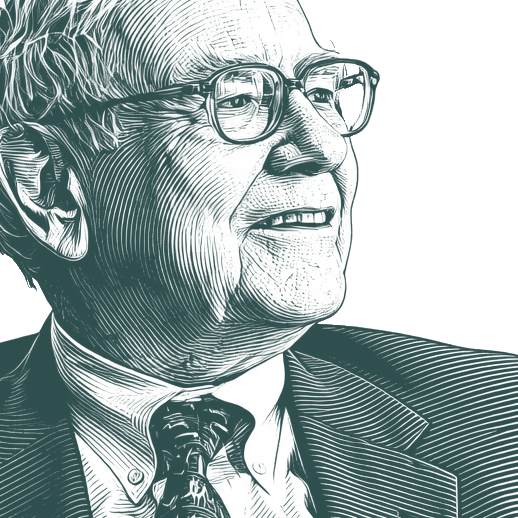
Warren Edward Buffett (born 30 August 1930) is an American business magnate, investor, and philanthropist. He is currently the chairman and CEO of Berkshire Hathaway. He is one of the most successful investors in the world and has a net worth of over $113 billion as of June 2022, making him the world's fifth-wealthiest person.
Bio from: Wikiquote (CC BY-SA 4.0) · Portrait adapted from: Wikimedia Commons, Mark Hirschey (CC BY-SA)
Also Known As:
The Oracle of Omaha
Alternative Names:
Warren Edward Buffett
From Wikidata (CC0)

Those who attended [the annual meeting] last year saw your Chairman pitch to Ernie Banks. This encounter proved to be the titanic duel that the sports world had long awaited. After the first few pitches — which were not my best, but when have I ever thrown my best? — I fired a brushback at Ernie just to let him know who was in command. Ernie charged the mound, and I charged the plate. But a clash was avoided because we became exhausted before reaching each other.
Intrinsic value can be defined simply: It is the discounted value of the cash that can be taken out of a business during its remaining life. The calculation of intrinsic value, though, is not so simple. As our definition suggests, intrinsic value is an estimate rather than a precise figure, and it is additionally an estimate that must be changed if interest rates move or forecasts of future cash flows are revised.
Our future rates of gain will fall far short of those achieved in the past. Berkshire's capital base is now simply too large to allow us to earn truly outsized returns. If you believe otherwise, you should consider a career in sales but avoid one in mathematics (bearing in mind that there are really only three kinds of people in the world: those who can count and those who can't).
But now for the final exam: If you expect to be a net saver during the next five years, should you hope for a higher or lower stock market during that period? Many investors get this one wrong. Even though they are going to be net buyers of stocks for many years to come, they are elated when stock prices rise and depressed when they fall. In effect, they rejoice because prices have risen for the "hamburgers" they will soon be buying. This reaction makes no sense. Only those who will be sellers of equities in the near future should be happy at seeing stocks rise. Prospective purchasers should much prefer sinking prices.
In a bull market, one must avoid the error of the preening duck that quacks boastfully after a torrential rainstorm, thinking that its paddling skills have caused it to rise in the world. A right-thinking duck would instead compare its position after the downpour to that of the other ducks on the pond.
Of course, Charlie and I can identify only a few Inevitables, even after a lifetime of looking for them. Leadership alone provides no certainties: Witness the shocks some years back at General Motors, IBM and Sears, all of which had enjoyed long periods of seeming invincibility. Though some industries or lines of business exhibit characteristics that endow leaders with virtually insurmountable advantages, and that tend to establish Survival of the Fattest as almost a natural law, most do not. Thus, for every Inevitable, there are dozens of Impostors, companies now riding high but vulnerable to competitive attacks.
The sad fact is that most major acquisitions display an egregious imbalance: They are a bonanza for the shareholders of the acquiree; they increase the income and status of the acquirer's management; and they are a honey pot for the investment bankers and other professionals on both sides. But, alas, they usually reduce the wealth of the acquirer's shareholders, often to a substantial extent. That happens because the acquirer typically gives up more intrinsic value than it receives. Do that enough, says John Medlin, the retired head of Wachovia Corp., and "you are running a chain letter in reverse." ... The acquisition problem is often compounded by a biological bias: Many CEOs attain their position in part because they possess an abundance of animal spirits and ego.
Just because Charlie and I can clearly see dramatic growth ahead for an industry does not mean we can judge what its profit margins and returns on capital will be as a host of competitors battle for supremacy. At Berkshire we will stick with businesses whose profit picture for decades to come seems reasonably predictable. Even then, we will make plenty of mistakes.
The strategy we've adopted precludes our following standard diversification dogma. Many pundits would therefore say the strategy must be riskier than that employed by more conventional investors. We disagree. We believe that a policy of portfolio concentration may well decrease risk if it raises, as it should, both the intensity with which an investor thinks about a business and the comfort-level he must feel with its economic characteristics before buying into it. In stating this opinion, we define risk, using dictionary terms, as "the possibility of loss or injury."
We've long felt that the only value of stock forecasters is to make fortune tellers look good. Even now, Charlie and I continue to believe that short-term market forecasts are poison and should be kept locked up in a safe place, away from children and also from grown-ups who behave in the market like children.
After 25 years of buying and supervising a great variety of businesses, Charlie and I have not learned how to solve difficult business problems. What we have learned is to avoid them. To the extent we have been successful, it is because we concentrated on identifying one-foot hurdles that we could step over because we acquired any ability to clear seven-footers.