Presently we saw a curious thing: There were no clouds, the sun was going down in a limpid, gold-washed sky. Just as the lower edge of the red disk rested on the high fields against the horizon, a great black figure suddenly appeared on the face of the sun. We sprang to our feet, straining our eyes toward it. In a moment we realized what it was. On some upland farm, a plough had been left standing in the field. The sun was sinking just behind it. Magnified across the distance by the horizontal light, it stood out against the sun, was exactly contained within the circle of the disk; the handles, the tongue, the share — black against the molten red. There it was, heroic in size, a picture writing on the sun.
American writer (1873–1947)
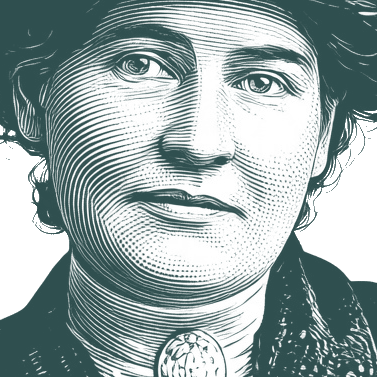
Willa Sibert Cather (7 December 1873 – 24 April 1947) is among the most eminent American authors, known for her depictions of US life in her novels.
Bio from: Wikiquote (CC BY-SA 4.0) · Portrait adapted from: Wikimedia Commons, Photographer: Aime Dupont Studio, New York (Public domain / CC0)
Alternative Names:
Willa Sibert Cather
•
Wilella Sibert “Willa” Cather
•
Wilella Sibert Cather
From Wikidata (CC0)

Showing quotes in randomized order to avoid selection bias. Click Popular for most popular quotes.
Enhance Your Quote Experience
Enjoy ad-free browsing, unlimited collections, and advanced search features with Premium.
If words had cost money, Tom couldn't have used them more sparingly. The adjectives were purely descriptive, relating to form and colour, and were used to present the objects under consideration, not the young explorer's emotions. Yet through this austerity one felt the kindling imagination, the ardour and excitement of the boy, like the vibration in a voice when the speaker strives to conceal his emotion by using only the conventional phrases.
He had seen the end of an era, the sunset of the pioneer. He had come upon it when already its glory was nearly spent. So in the buffalo times a traveller used to come upon the embers of a hunter's fire on the prairies, after the hunter was up and gone; the coals would be trampled out, but the ground was warm, and the flattened grass where he had slept and where his pony had grazed, told the story. This was the very end of the road-making West; the men who had put plains and mountains under the iron harness were old; some were poor, and even the successful ones were hunting for rest and a brief reprieve from death. It was already gone, that age; nothing could ever bring it back. The taste and smell and song of it, the visions those men had seen in the air and followed, — these he had caught in a kind of afterglow in their own faces, — and this would always be his.
We are all alike; we have no ties, we know nobody, we own nothing. When one of us dies, they scarcely know where to bury him. Our landlady and the delicatessen man are our mourners, and we leave nothing behind us but a frock-coat and a fiddle, or an easel, or a typewriter, or whatever took we got our living by. All we have ever managed to do is to pay our rent, that exorbitant rent that one has to pay for a few square feet of space near the heart of things. We have no house, no place, no people of our own. We live in the streets, in the parks, in the theaters. We sit in restaurants and concert halls and look about at the hundreds of our own kind and shudder.
The windy springs and the blazing summers, one after another, had enriched and mellowed that flat tableland; all the human effort that had gone into it was coming back in long, sweeping lines of fertility. The changes seemed beautiful and harmonious to me; it was like watching the growth of a great man or of a great idea. I recognized every tree and sandbank and rugged draw. I found that I remembered the conformation of the land as one remembers the modelling of human faces.
Now everything was in ruins. The air was still and cold like the air in a refrigerating-room. What I felt was fear; I was afraid to look or speak or move. Everything about me seemed evil. When kindness has left people, even for a few moments, we become afraid of them, as if their reason had left them. When it has left a place where we have always found it, it is like shipwreck; we drop from security into something malevolent and bottomless.
PREMIUM FEATURE
Advanced Search Filters
Filter search results by source, date, and more with our premium search tools.