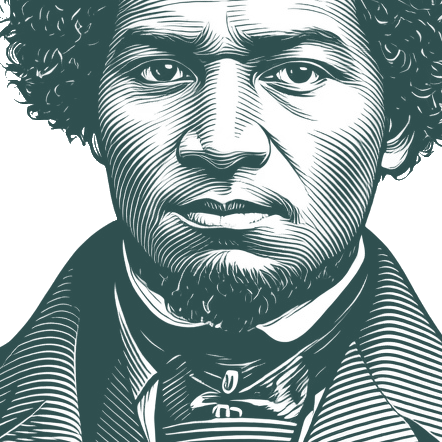
The man who wields the blood-clotted cowskin during the week fills the pulpit on Sunday, and claims to be a minister of the meek and lowly Jesus. The… - Frederick Douglass
""
The man who wields the blood-clotted cowskin during the week fills the pulpit on Sunday, and claims to be a minister of the meek and lowly Jesus. The man who robs me of my earnings at the end of each week meets me as a class- leader on Sunday morning, to show me the way of life, and the path of salvation. He who sells my sister, for purposes of prostitution, stands forth as the pious advocate of purity. He who proclaims it a religious duty to read the Bible denies me the right of learning to read the name of the God who made me. He who is the religious advocate of marriage robs whole millions of its sacred influence, and leaves them to the ravages of wholesale pollution. The warm defender of the sacredness of the family relation is the same that scatters whole families, — sundering husbands and wives, parents and children, sisters and brothers, — leaving the hut vacant, and the hearth desolate. We see the thief preaching against theft, and the adulterer against adultery. We have men sold to build churches, women sold to support the gospel, and babes sold to purchase Bibles for the poor heathen! all for the glory of God and the good of souls! The slave auctioneer’s bell and the church-going bell chime in with each other, and the bitter cries of the heart-broken slave are drowned in the religious shouts of his pious master. Revivals of religion and revivals in the slave-trade go hand in hand together. The slave prison and the church stand near each other. The clanking of fetters and the rattling of chains in the prison, and the pious psalm and solemn prayer in the church, may be heard at the same time. The dealers in the bodies and souls of men erect their stand in the presence of the pulpit, and they mutually help each other. The dealer gives his blood-stained gold to support the pulpit, and the pulpit, in return, covers his infernal business with the garb of Christianity. Here we have religion and robbery the allies of each other — devils dressed in angels’ robes, a
Frederick Douglass (c. February 1818 – 20 February 1895) was an American abolitionist, orator, author, editor, reformer, women's rights advocate, and statesman during the American Civil War. He was born a slave in Maryland, as Frederick Augustus Washington Bailey.
Biography information from
Wikiquote·
Portrait adapted from
Wikimedia Commons, Engraved by J.C. Buttre from a daguerreotype. (Public domain / CC0)
Also Known As
Birth Name:
Frederick Augustus Washington Bailey
Alternative Names:
Frederick Augustus Washington Baly
•
Fred Bailey
•
Freddie Bailey
The dissolution of the Union would not give the North a single advantage over slavery, but would take from it many. Within the Union we have a firm basis of opposition to slavery. It is opposed to all the great objects of the Constitution. The dissolution of the Union is not only an unwise but a cowardly measure; fifteen millions running away from three hundred and fifty thousand slaveholders. Mr. Garrison and his friends tell us that while in the Union we are responsible for slavery. He and they sing out 'No Union with slaveholders', and refuse to vote. I admit our responsibility for slavery while in the Union but I deny that going out of the Union would free us from that responsibility. There now clearly is no freedom from responsibility for slavery to any American citizen short to the abolition of slavery. The American people have gone quite too far in this slaveholding business now to sum up their whole business of slavery by singing out the cant phrase, "No union with slaveholders". To desert the family hearth may place the recreant husband out of the presence of his starving children, but this does not free him from responsibility. If a man were on board of a pirate ship, and in company with others had robbed and plundered, his whole duty would not be preformed simply by taking the longboat and singing out, 'No union with pirates'. His duty would be to restore the stolen property.
Southern gentlemen who led in the late rebellion have not parted with their convictions at this point, any more than at any other. They want to be independent of the negro. They believed in slavery and they believe in it still. They believed in an aristocratic class, and they believe in it still, and though they have lost slavery, one element essential to such a class, they still have two important conditions to the reconstruction of that class. They have intelligence, and they have land. Of these, the land is the more important. They cling to it with all the tenacity of a cherished superstition. They will neither sell to the negro, nor let the carpet-bagger have it in peace, but are determined to hold it for themselves and their children forever. They have not yet learned that when a principle is gone, the incident must go also; that what was wise and proper under slavery is foolish and mischievous in a state of general liberty; that the old bottles are worthless when the new wine has come; but they have found that land is a doubtful benefit, where there're no hands to till it. Hence these gentlemen have turned their attention to the Celestial Empire. They would rather have laborers who would work for nothing; but as they cannot get the negro on these terms, they want Chinamen, who, they hope, will work for next to nothing.
Works in ChatGPT, Claude, or Any AI
Add semantic quote search to your AI assistant via MCP. One command setup.
Of course this result will not be reached by any hurried or forced processes. It will not arise out of any theory of the wisdom of such blending of the two races. If it comes at all, it will come without shock or noise or violence of any kind, and only in the fullness of time, and it will be so adjusted to surrounding conditions as hardly to be observed. I would not be understood as advocating intermarriage between the two races. I am not a propagandist, but a prophet. I do not say that what I say should come to pass, but what I think is likely to come to pass, and what is inevitable. While I would not be understood as advocating the desirability of such a result, I would not be understood as deprecating it.