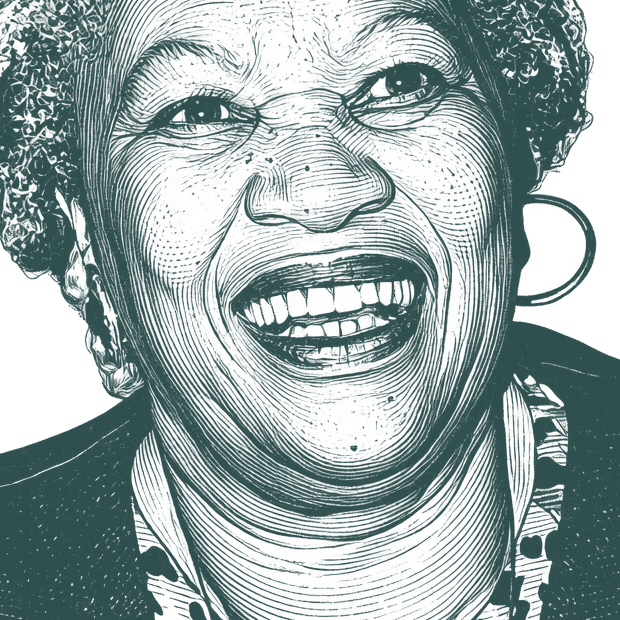
Make up a story... For our sake and yours forget your name in the street; tell us what the world has been to you in the dark places and in the light.… - Toni Morrison
""
Make up a story... For our sake and yours forget your name in the street; tell us what the world has been to you in the dark places and in the light. Don't tell us what to believe, what to fear. Show us belief's wide skirt and the stitch that unravels fear's caul.
Chloe Anthony Wofford Morrison (born Chloe Ardelia Wofford February 18, 1931 – August 5, 2019), known as Toni Morrison, was an American novelist, essayist, book editor, and college professor, who received a Pulitzer Prize in 1988 and the Nobel Prize in Literature in 1993.
Biography information from
Wikiquote·
Portrait adapted from
Wikimedia Commons, John Mathew Smith (celebrity-photos.com) (CC BY-SA)
Also Known As
Birth Name:
Chloe Ardelia Wofford
Alternative Names:
Chloe Anthony Wofford
•
Chloe Anthony Wofford Morrison
•
Chloe Anthony Wofford-Morrison
I did it. I got us all out. Without Halle too. Up till then it was the only thing I ever did on my own. Decided. And it came off right, like it was suppose to. We was here. Each and every one of my babies and me too. I birthed them and I got em out and it wasn't no accident. I had help, of course, lots of that, but still it was me doing it; me saying Go on, and Now. Me having to look out. Me using my own head. But it was more than that. It was kind of selfishness I never knew nothing about before. It felt good. Good and right. I was big, Paul D, and deep and wide and when I stretched out my arms all my children could get in between. I was that wide. Look like I loved em more after I got here. Or maybe I couldn't love em proper in Kentucky because they wasn't mine to love. But when I got here, when I jumped down off that wagon — there wasn't nobody in the world I couldn't love if I wanted to. You know what I mean?
…one day, alone in the kitchen with my father, I let drop a few whines about the job. I gave him details, examples of what troubled me, yet although he listened intently, I saw no sympathy in his eyes. No "Oh, you poor little thing."
Perhaps he understood that what I wanted was a solution to the job, not an escape from it. In any case, he put down his cup of coffee and said, "Listen. You don't live there. You live here. With your people. Go to work. Get your money. And come on home."
That was what he said. This was what I heard:
1. Whatever the work is, do it well—not for the boss but for yourself.
2. You make the job; it doesn't make you.
3. Your real life is with us, your family.
4. You are not the work you do; you are the person you are.
I have worked for all sorts of people since then, geniuses and morons, quick-witted and dull, bighearted and narrow. I've had many kinds of jobs, but since that conversation with my father I have never considered the level of labor to be the measure of myself, and I have never placed the security of a job above the value of home.
Unlimited Quote Collections
Organize your favorite quotes without limits. Create themed collections for every occasion with Premium.
Born Joshua, he renamed himself when he handed over his wife to his master’s son. Handed her over in the e sense that he did not kill anybody, thereby himself, because his wife demanded he stay alive. Otherwise sense that he did not kill anybody, thereby himself, because his wife demanded he stay alive. Otherwise, she reasoned, where and to whom could she return when the boy was through? With that gift, he decided that he didn’t owe anybody anything. Whatever his obligations were, that act paid them off. He thought it would make him rambunctious, renegade—a drunkard even, the debtlessness, and in a way it did. But there was nothing to do with it. Work well; work poorly. Work a little; work not at all. Make sense; make none. Sleep, wake up; like somebody, dislike others. It didn’t seem much of a way to live and it brought him no satisfaction. So he extended this debtlessness to other people by helping them pay out and off whatever they owed in misery. Beaten runaways? He ferried them and rendered them paid for; gave them their own bill of sale, so to speak. “You paid it; now life owes you.” And the receipt, as it were, was a welcome door that he never had to knock on, like John and Ella’s in front of which he stood and said, “Who in there?” only once and she was pulling on the hinge.