I am Beloved and she is mine. I see her take flowers away from leaves she puts them in a round basket the leaves are not for her she fills the basket she opens the grass I would help her but the clouds are in the way how can I say things that are pictures I am not separate from her there is no place where I stop her face is my own and I want to be there in the place where her face is and to be looking at it too a hot thing.
African American novelist, essayist, and academic (1931–2019)
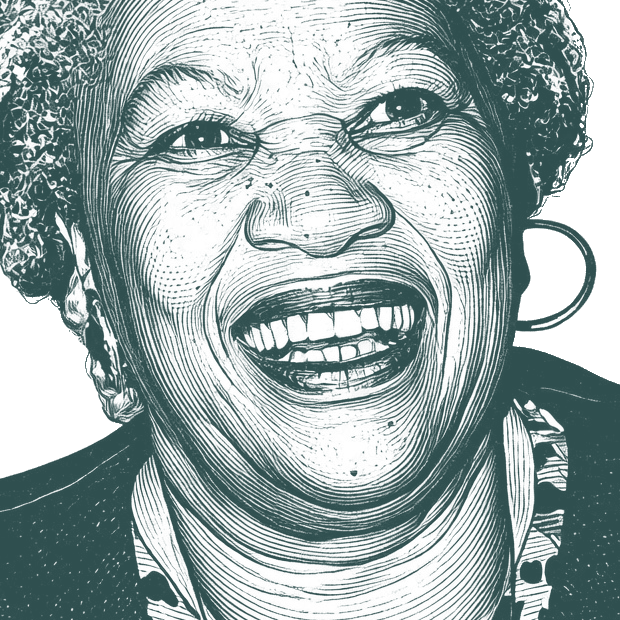
Chloe Anthony Wofford Morrison (born Chloe Ardelia Wofford February 18, 1931 – August 5, 2019), known as Toni Morrison, was an American novelist, essayist, book editor, and college professor, who received a Pulitzer Prize in 1988 and the Nobel Prize in Literature in 1993.
Bio from: Wikiquote (CC BY-SA 4.0) · Portrait adapted from: Wikimedia Commons, John Mathew Smith (celebrity-photos.com) (CC BY-SA)
Birth Name:
Chloe Ardelia Wofford
Alternative Names:
Chloe Anthony Wofford
•
Chloe Anthony Wofford Morrison
•
Chloe Anthony Wofford-Morrison
From Wikidata (CC0)
Showing quotes in randomized order to avoid selection bias. Click Popular for most popular quotes.
PREMIUM FEATURE
Advanced Search Filters
Filter search results by source, date, and more with our premium search tools.
Something's the matter. What's the matter? What's the matter? She asked herself. She didn't know what she looked like and was not curious. But suddenly she saw her hands and thought with a clarity as simple as it was dazzling, "These hands belong to me. These my hands." Next she felt a knocking in her chest and discovered something else new: her own heartbeat. Had it been there all along? This pounding thing? She felt like a fool and began to laugh out loud.
When warm weather came, Baby Suggs, holy, followed by every black man, woman, and child who could make it through, took her great heart to the Clearing — a wide-open place cut deep in the woods nobody knew for what at the end of the path known only to deer and whoever cleared the land in the first place. In the heat of every Saturday afternoon, she sat in the clearing while the people waited among the trees.
After situating herself on a huge flat-sided rock, Baby Suggs bowed her head and prayed silently. The company watched her from the trees. They knew she was ready when she put her stick down. Then she shouted, 'Let the children come!' and they ran from the trees toward her.
Let your mothers hear you laugh,' she told them, and the woods rang. The adults looked on and could not help smiling.
Then 'Let the grown men come,' she shouted. They stepped out one by one from among the ringing trees.
Let your wives and your children see you dance,' she told them, and groundlife shuddered under their feet.
Finally she called the women to her. 'Cry,' she told them. 'For the living and the dead. Just cry.' And without covering their eyes the women let loose.
It started that way: laughing children, dancing men, crying women and then it got mixed up. Women stopped crying and danced; men sat down and cried; children danced, women laughed, children cried until, exhausted and riven, all and each lay about the Clearing damp and gasping for breath. In the silence that followed, Baby Suggs, holy, offered up to them her great big heart.
She did not tell them to clean up their lives or go and sin no more. She did not tell them they were the blessed of the earth, its inheriting meek or its glorybound pure.
She told them that the only grace they could have was the grace they could imagine. That if they could not see it, they would not have it.
Here,' she said, 'in this here place, we flesh; flesh that weeps, laughs; flesh that dances on bare feet in grass. Love it. Love it hard..
She had been looking all along for a friend, and it took her a while to discover that a lover was not a comrade and could never be - for a woman. And that no one would ever be that version of herself which she sought to reach out to and touch with an ungloved hand. There was only her own mood and whim, and if that was all there was, she decided to turn the naked hand toward it, discover it and let others become as intimate with their own selves as she was.
Anybody white could take your whole self for anything that came to mind. Not just work, kill, or maim you, but dirty you. Dirty you so bad you couldn't like yourself anymore. And though she and others lived through and got over it, she could never let it happen to her own. The best things she was, was her children. Whites might dirty her all right, but not her best thing, her beautiful, magical best thing — the part of her that was clean.
The vitality of language lies in its ability to limn the actual, imagined and possible lives of its speakers, readers, writers. Although its poise is sometimes in displacing experience it is not a substitute for it. It arcs toward the place where meaning may lie. When a President of the United States thought about the graveyard his country had become, and said, "The world will little note nor long remember what we say here. But it will never forget what they did here," his simple words are exhilarating in their life-sustaining properties because they refused to encapsulate the reality of 600, 000 dead men in a cataclysmic race war. Refusing to monumentalize, disdaining the "final word", the precise "summing up", acknowledging their "poor power to add or detract", his words signal deference to the uncapturability of the life it mourns.
You looked at them and wondered why they were so ugly; you looked closely and could not find the source. Then you realized that it came from conviction, their conviction. It was as though some mysterious all-knowing master had given each one a cloak of ugliness to wear, and they had each accepted it without question.
Beginning Beloved with numerals rather than spelled out numbers, it was my intention to give the house an identity separate from the street or even the city... Numbers here constitute an address, a thrilling enough prospect for slaves who had owned nothing, least of all an address. And although the numbers, unlike words, can have no modifiers, I give these an adjective — spiteful… A few words have to be read before it is clear that 124 refers to a house … and a few more have to be read to discover why it is spiteful, or rather the source of the spite. By then it is clear, if not at once, that something is beyond control, but is not beyond understanding since it is not beyond accommodation by both the "women" and the "children." The fully realized presence of the haunting is both a major incumbent of the narrative and sleight of hand. One of its purposes is to keep the reader preoccupied with the nature of the incredible spirit world while being supplied a controlled diet of the incredible political world. … Here I wanted the compelling confusion of being there as they (the characters) are; suddenly, without comfort or succor from the "author," with only imagination, intelligence, and necessity available for the journey. …. No compound of houses, no neighborhood, no sculpture, no paint, no time, especially no time because memory, pre-historic memory, has no time. There is just a little music, each other and the urgency of what is at stake. Which is all they had. For that work, the work of language is to get out of the way.
"Anger ... it's a paralyzing emotion ... you can't get anything done. People sort of think it's an interesting, passionate, and igniting feeling — I don't think it's any of that — it's helpless ... it's absence of control — and I need all of my skills, all of the control, all of my powers ... and anger doesn't provide any of that — I have no use for it whatsoever."
[Interview with CBS radio host Don Swaim, September 15, 1987.]
You think because he doesn't love you that you are worthless. You think that because he doesn't want you anymore that he is right — that his judgement and opinion of you are correct. If he throws you out, then you are garbage. You think he belongs to you because you want to belong to him. Don't. It's a bad word, 'belong.' Especially when you put it with somebody you love. Love shouldn't be like that. Did you ever see the way the clouds love a mountain? They circle all around it; sometimes you can't even see the mountain for the clouds. But you know what? You go up top and what do you see? His head. The clouds never cover the head. His head pokes through, beacuse the clouds let him; they don't wrap him up. They let him keep his head up high, free, with nothing to hide him or bind him. You can't own a human being. You can't lose what you don't own. Suppose you did own him. Could you really love somebody who was absolutely nobody without you? You really want somebody like that? Somebody who falls apart when you walk out the door? You don't, do you? And neither does he. You're turning over your whole life to him. Your whole life, girl. And if it means so little to you that you can just give it away, hand it to him, then why should it mean any more to him? He can't value you more than you value yourself.