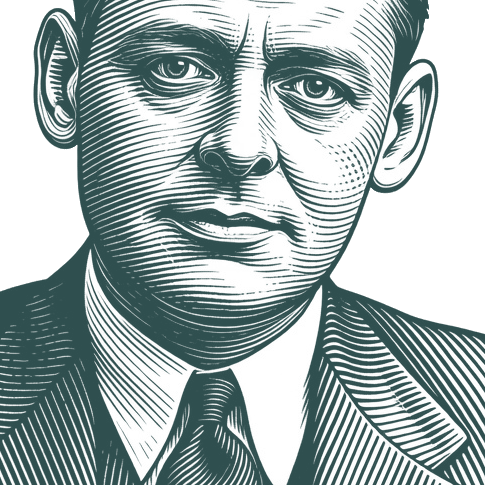
[T]he German national religion […] expounded by Professor Wilhelm Hauer […] is deistic, claiming to 'worship a more than human God'. He believes it t… - T. S. Eliot
""
[T]he German national religion […] expounded by Professor Wilhelm Hauer […] is deistic, claiming to 'worship a more than human God'. He believes it to be 'an eruption from the biological and spiritual depths of the German nation', and unless one is prepared to deny that the German nation has such depths, I do not see that the statement can be ridiculed. He believes that 'each new age must mold its own religious forms'—alas, many persons in Anglo-Saxon countries hold the same belief. He believes […] also in something very popular in this country, the religion of the blue sky, the grass and flowers.[…] The German National Religion, as Hauer expounds it, turns out to be something with which we are already familiar. So, if the German Religion is also your religion, the sooner you realise the fact the better.
English
Collect this quote
About
T. S. Eliot
Thomas Stearns Eliot (26 September 1888 – 4 January 1965) was an American-born English poet, dramatist and literary critic. Noted for spiritual and religious themes in many of his poems, he converted from Unitarianism to Anglicanism in 1927.
Biography information from
Wikiquote·
Portrait adapted from
Wikimedia Commons, Thomas Stearns Eliot with his sister and his cousin by Lady Ottoline Morrell.jpg: Lady Ottoline Morrell (1873–1938) derivative work: Octave.H (Public domain / CC0)
Also Known As
Birth Name:
Thomas Stearns Eliot
Alternative Names:
Eliot
•
T S Eliot
•
Thomas Eliot
•
T.S. Eliot
What we call the beginning is often the end And to make and end is to make a beginning. The end is where we start from. And every phrase And sentence that is right (where every word is at home, Taking its place to support the others, The word neither diffident nor ostentatious, An easy commerce of the old and the new, The common word exact without vulgarity, The formal word precise but not pedantic, The complete consort dancing together) Every phrase and every sentence is an end and a beginning, Every poem an epitaph. And any action Is a step to the block, to the fire, down the sea's throat Or to an illegible stone: and that is where we start. We die with the dying: See, they depart, and we go with them. We are born with the dead: See, they return, and bring us with them. The moment of the rose and the moment of the yew-tree Are of equal duration. A people without history Is not redeemed from time, for history is a pattern Of timeless moments. So, while the light fails On a winter's afternoon, in a secluded chapel History is now and England.
Do I dare Disturb the universe? In a minute there is time For decisions and revisions which a minute will reverse. For I have known them all already, known them all: — Have known the evenings, mornings, afternoons, I have measured out my life with coffee spoons; I know the voices dying with a dying fall Beneath the music from a farther room.
Enhance Your Quote Experience
Enjoy ad-free browsing, unlimited collections, and advanced search features with Premium.
When the Stranger says: “What is the meaning of this city ? Do you huddle close together because you love each other?” What will you answer? “We all dwell together To make money from each other”? or “This is a community”? Oh my soul, be prepared for the coming of the Stranger. Be prepared for him who knows how to ask questions.