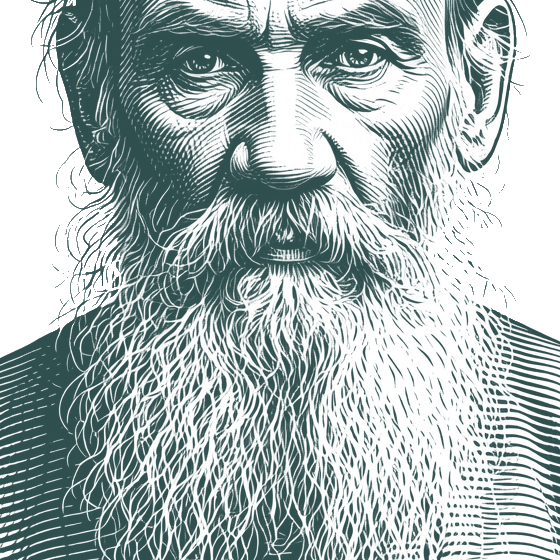
When a person is haughty, he distances himself from other people and thereby deprives himself of one of life's biggest pleasures—open, joyful communi… - Leo Tolstoy
""
When a person is haughty, he distances himself from other people and thereby deprives himself of one of life's biggest pleasures—open, joyful communication with everyone.
English
Collect this quote
About
Leo Tolstoy
Lev Nikolayevitch Tolstoy [Ле́в Никола́евич Толсто́й, usually rendered Leo Tolstoy, or sometimes Tolstoi] (9 September 1828 – 20 November 1910) was a Russian writer, philosopher and social activist (social critic), whose novels War and Peace and Anna Karenina are internationally praised classics of world literature. He was a major influence on the development of Christian anarchism and pacifism, contributing to such nonviolent resistance movements as those of Mahatma Gandhi, Martin Luther King, Jr., and James Bevel.
Biography information from
Wikiquote·
Portrait adapted from
Wikimedia Commons, Sergei Prokudin-Gorskii (Public domain / CC0)
Also Known As
Pen Names:
Л. Н. Т.
•
Л. Н.
Birth Name:
Lev Nikolayevich Tolstoy
Native Name:
Лев Никола́евич Толсто́й
Alternative Names:
Count Lev Nikolayevich Tolstoy
•
Tolstoy, Leo, graf, 1828-1910
•
Tolstoĭ, Lev Nikolaevich, graf, 1828-1910
•
Lev Nikolayevich Tolstoĭ
•
Leo Tolstoi
•
Tolstoĭ, Lev Nikolaevich, graf
•
Tolstoy, Leo, graf
He knew that Vronsky could not be prevented from amusing himself with painting; he knew that he and all dilettanti had a perfect right to paint what they liked, but it was distasteful to him. A man could not be prevented from making himself a big wax doll, and kissing it. But if the man were to come with the doll and sit before a man in love, and began caressing his doll as the lover caressed the woman he loved, it would be distasteful to the lover. Just such a distasteful sensation was what Mihailov felt at the sight of Vronsky’s painting: he felt it both ludicrous and irritating, both pitiable and offensive.
The Lord had given them the day and the Lord had given them the strength. And the day and the strength had been dedicated to labor, and the labor was its reward. Who was the labor for? What would be its fruits? These were irrelevant and idle questions.
PREMIUM FEATURE
Advanced Search Filters
Filter search results by source, date, and more with our premium search tools.