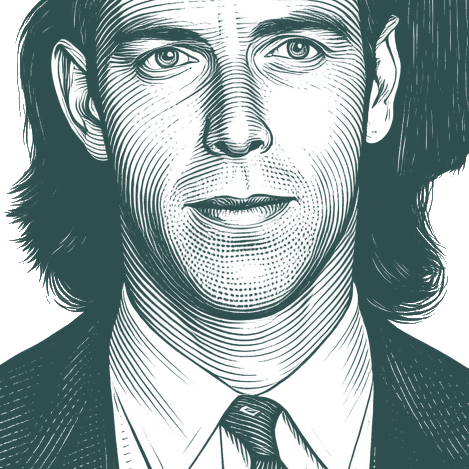
Alan Wilson Watts (6 January 1915 – 16 November 1973) was an English philosopher, writer, speaker, and expert in comparative religion.
Biography information from
Wikiquote·
Portrait adapted from
Wikimedia Commons, The University of Vermont Alumni Magazine vol. 39 no. 01, p. 22. (Public domain / CC0)
Also Known As
Alternative Names:
Alan Wilson Watts
•
Alan W. Watts
Portrait from Wikimedia Commons. Credit: The University of Vermont Alumni Magazine vol. 39 no. 01, p. 22.. Used under Public domain / CC0. Processed and styled by Quotewise.
Limited Time Offer
Premium members can get their quote collection automatically imported into their Quotewise collections.
Perception thus narrowed has the advantage of being sharp and bright, but it has to focus on one area of the world after another, and one feature after another. And where there are no features, only space or uniform surfaces, it somehow gets bored and searches about for more features. Attention is therefore something like a scanning mechanism in radar or television, and Norbert Wiener and his colleagues found some evidence that there is a similar process in the brain.
I am depressed, and want to get “I” out of this depression. The opposite of depression is elation, but because depression is not elation, I cannot force myself to be elated. I can, however, get drunk. This makes me wonderfully elated, and so when the next depression arrives, I have a quick cure. The subsequent depressions have a way of getting deeper and blacker, because I am not digesting the depressed state and eliminating its poisons. So I need to get even drunker to drown them. Very soon I begin to hate myself for getting so drunk, which makes me still more depressed — and so it goes.
Enhance Your Quote Experience
Enjoy ad-free browsing, unlimited collections, and advanced search features with Premium.
Human desire tends to be insatiable. We are so anxious for pleasure that we can never get enough of it. We stimulate our sense organs until they become insensitive, so that if pleasure is to continue they must have stronger and stronger stimulants. In self-defense the body gets ill from the strain, but the brain wants to go on and on. The brain is in pursuit of happiness, and because the brain is much more concerned about the future than the present, it conceives happiness as the guarantee of an indefinitely long future of pleasures. Yet the brain also knows that it does not have an indefinitely long future, so that, to be happy, it must try to crowd all the pleasures of Paradise and eternity into the span of a few years.