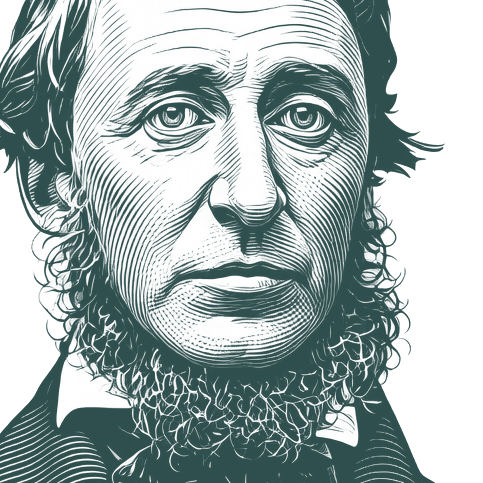
Henry David Thoreau (12 July 1817 – 6 May 1862) was an American essayist, poet, philosopher, abolitionist, naturalist, tax resister, development critic, surveyor, and historian. A leading transcendentalist, Thoreau is best known for his book Walden, a reflection upon simple living in natural surroundings, and his essay Resistance to Civil Government (also known as Civil Disobedience), an argument for disobedience to an unjust state.
Biography information from
Wikiquote·
Portrait adapted from
Wikimedia Commons, B. D. Maxham (Public domain / CC0)
Also Known As
Birth Name:
David Henry Thoreau
Alternative Names:
Thoreau
•
Henry D. Thoreau
•
Henry Thoreau
The community has no bribe that will tempt a wise man. You may raise money enough to tunnel a mountain, but you cannot raise money enough to hire a man who is minding his own business. An efficient and valuable man does what he can, whether the community pay him for it or not. The inefficient offer their inefficiency to the highest bidder, and are forever expecting to be put into office. One would suppose that they were rarely disappointed.
All voting is a sort of gaming, like checkers or backgammon, with a slight moral tinge to it, a playing with right and wrong, with moral questions; and betting naturally accompanies it. The character of the voters is not staked. I cast my vote, perchance, as I think right; but I am not vitally concerned that that right should prevail. I am willing to leave it to the majority. Its obligation, therefore, never exceeds that of expediency. Even voting for the right is doing nothing for it. It is only expressing to men feebly your desire that it should prevail. A wise man will not leave the right to the mercy of chance, nor wish it to prevail through the power of the majority. There is but little virtue in the action of masses of men. When the majority shall at length vote for the abolition of slavery, it will be because they are indifferent to slavery, or because there is but little slavery left to be abolished by their vote. They will then be the only slaves. Only his vote can hasten the abolition of slavery who asserts his own freedom by his vote.
Go Premium
Support Quotewise while enjoying an ad-free experience and premium features.