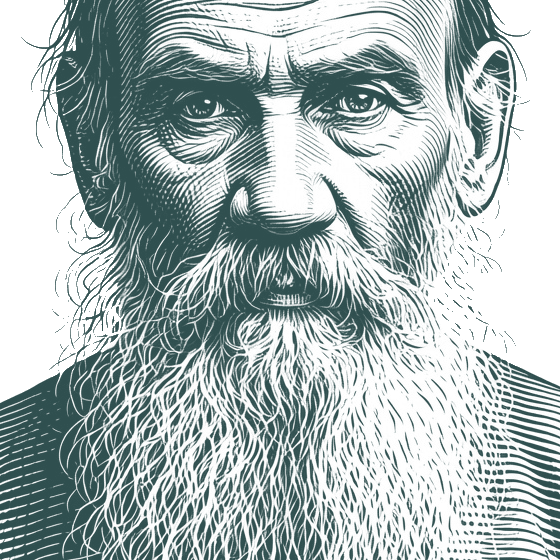
In the depth of his soul he knew that his action was so base, abominable and cruel that, with that action upon his conscience, not only would he have… - Leo Tolstoy
""
In the depth of his soul he knew that his action was so base, abominable and cruel that, with that action upon his conscience, not only would he have no right to condemn others but he should not be able to look others in the face, to say nothing of considering himself the good, noble, magnanimous man he esteemed himself. And he had to esteem himself as such in order to be able to continue to lead a valiant and joyous life. And there was but one way of doing so, and that was not to think of it. This he endeavored to do.
Lev Nikolayevitch Tolstoy [Ле́в Никола́евич Толсто́й, usually rendered Leo Tolstoy, or sometimes Tolstoi] (9 September 1828 – 20 November 1910) was a Russian writer, philosopher and social activist (social critic), whose novels War and Peace and Anna Karenina are internationally praised classics of world literature. He was a major influence on the development of Christian anarchism and pacifism, contributing to such nonviolent resistance movements as those of Mahatma Gandhi, Martin Luther King, Jr., and James Bevel.
Biography information from
Wikiquote·
Portrait adapted from
Wikimedia Commons, Sergei Prokudin-Gorskii (Public domain / CC0)
Also Known As
Pen Names:
Л. Н. Т.
•
Л. Н.
Birth Name:
Lev Nikolayevich Tolstoy
Native Name:
Лев Никола́евич Толсто́й
Alternative Names:
Count Lev Nikolayevich Tolstoy
•
Tolstoy, Leo, graf, 1828-1910
•
Tolstoĭ, Lev Nikolaevich, graf, 1828-1910
•
Lev Nikolayevich Tolstoĭ
•
Leo Tolstoi
•
Tolstoĭ, Lev Nikolaevich, graf
•
Tolstoy, Leo, graf
The pleasure lies not in discovering truth, but in searching for it.
The recognition that love represents the highest morality was nowhere denied or contradicted, but this truth was so interwoven everywhere with all kinds of falsehoods which distorted it, that finally nothing of it remained but words. It was taught that this highest morality was only applicable to private life — for home use, as it were — but that in public life all forms of violence — such as imprisonment, executions, and wars — might be used for the protection of the majority against a minority of evildoers, though such means were diametrically opposed to any vestige of love.
Enhance Your Quote Experience
Enjoy ad-free browsing, unlimited collections, and advanced search features with Premium.
Never, never marry, my friend. Here’s my advice to you: don’t marry until you can tell yourself that you’ve done all you could, and until you’ve stopped loving the woman you’ve chosen, until you see her clearly, otherwise you’ll be cruelly and irremediably mistaken. Marry when you’re old and good for nothing…Otherwise all that’s good and lofty in you will be lost.