"Of a real, true contract, on whatsoever subject, there is no vestige in Rousseau's book. To give an
exact idea of his theory, I cannot do better tha… - Pierre-Joseph Proudhon
"Of a real, true contract, on whatsoever subject, there is no vestige in Rousseau's book. To give an exact idea of his theory, I cannot do better than compare it with a commercial agreement, in which the names of the parties, the nature and value of the goods, products and services involved, the conditions of quality, delivery, price, reimbursement, everything in fact which constitutes the material of contracts, is omitted, and nothing is mentioned but penalties and jurisdictions.
"Indeed, Citizen of Geneva, you talk well. But before holding forth about the sovereign and the prince, about the policeman and the judge, tell me first what is my share of the bargain? What? You expect me to sign an agreement in virtue of which I may be prosecuted for a thousand transgressions, by municipal, rural, river and forest police, handed over to tribunals, judged, condemned for damage, cheating, swindling, theft, bankruptcy, robbery, disobedience to the laws of the State, offence to public morals, vagabondage, — and in this agreement I find not a word of either my rights or my obligations, I find only penalties!
"But every penalty no doubt presupposes a duty, and every duty corresponds to a right. Where then in your agreement are my rights and duties? What have I promised to my fellow citizens? What have they promised to me? Show it to me, for without that, your penalties are but excesses of power, your law-controlled State a flagrant usurpation, your police, your judgment and your executions so many abuses. You who have so well denied property, who have impeached so eloquently the inequality of conditions among men, what dignity, what heritage, have you for me in your republic, that you should claim the right to judge me, to imprison me, to take my life and honor? Perfidious declaimer, have you inveighed so loudly against exploiters and tyrants, only to deliver me to them without defence?"
English
Collect this quote
About
Pierre-Joseph Proudhon
Pierre-Joseph Proudhon (pronounced [ˈpruːd.ɒn] in BrE, [pʁu.dɔ̃] in French) (15 January 1809 – 19 January 1865) was the first individual to call himself an "anarchist," and the first documented as using the word "Capitalist" to mean property-owner.
Biography information from
Wikiquote·
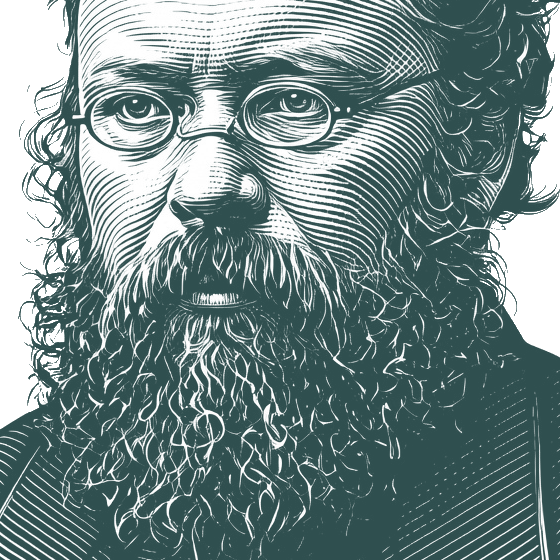
Portrait adapted from
Wikimedia Commons, Nadar (Public domain / CC0)
Also Known As
Alternative Names:
P.-J. Proudhon
•
Pierre Joseph Proudhon
•
Purūdon
•
Pʻu-lu-tung
•
Pʹer Zhozef Prudon
Habit, like a second nature, has the power of fixing in the mind new categorical forms derived from the appearances which impress us, and by them usually stripped of objective reality, but whose influence over our judgments is no less predetermining than that of the original categories. Hence we reason by the eternal and absolute laws of our mind, and at the same time by the secondary rules, ordinarily faulty, which are suggested to us by imperfect observation. This is the most fecund source of false prejudices, and the permanent and often invincible cause of a multitude of errors. The bias resulting from these prejudices is so strong that often, even when we are fighting against a principle which our mind thinks false, which is repugnant to our reason, and which our conscience disapproves, we defend it without knowing it, we reason in accordance with it, and we obey it while attacking it. Enclosed within a circle, our mind revolves about itself, until a new observation, creating within us new ideas, brings to view an external principle which delivers us from the phantom by which our imagination is possessed.
Mülkiyet hırsızlıktır.
PREMIUM FEATURE
Advanced Search Filters
Filter search results by source, date, and more with our premium search tools.
Power, instrument of the collective force, created in society to serve as mediator between capital and labor, has become inescapably enchained to capital and directed against the proletariat. No political reform can resolve this contradiction, since, according to the avowal of politicians themselves, such a reform could only end by giving more energy and expansion to power, and until it had overthrown the hierarchy and dissolved society, power would not be able to attack the prerogatives of monopoly. The problem consists, then, for the working classes, not in capturing, but in defeating both power and monopoly, which would mean to make rise from the bowels of the people, from the depths of labor, a power greater, an action more powerful which would envelop capital and the State and subjugate them.