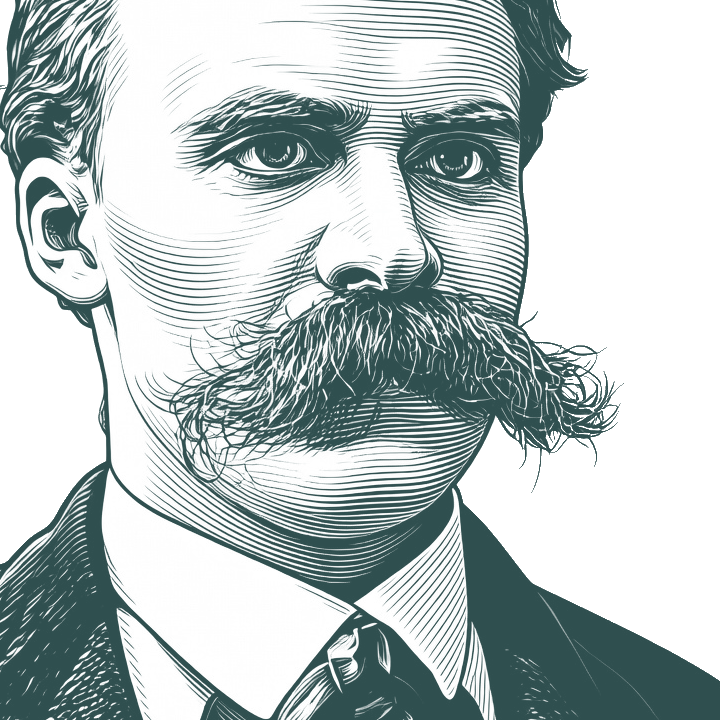
Friedrich Wilhelm Nietzsche (15 October 1844 – 25 August 1900) was a German philosopher, cultural critic, composer, poet, writer, and philologist whose work has exerted a profound influence on modern intellectual history. His critiques of contemporary culture, religion, and philosophy centered on a basic question regarding the foundation of values and morality.
Biography information from
Wikiquote·
Portrait adapted from
Wikimedia Commons, Friedrich Hermann Hartmann (Public domain / CC0)
Also Known As
Alternative Names:
Friedrich Wilhelm Nietzsche
•
Nietzsche
A politician divides mankind into two classes: tools and enemies.
There is a false saying, ‘Whoever cannot save himself - how can he save others?’ But if I have the key to your chains, why should your and my lock be the same.
Our evaluations. - All actions may be traced back to evaluations, all evaluations are original or adopted - the latter being by far the most common. Why do we adopt them? From fear - that is to say, we consider it more advisable to pretend they are our own - and accustom ourself to this pretense, so that at length it becomes our own nature. Original evaluation: that is to say, to assess a thing according to the extent to which it pleases or displeases us alone and no one else - something excessively rare! But must our evaluation of another, in which there lies motive for our general availing ourselves of his HIS evaluation, at least not proceed from US, be our OWN determination? Yes, but we arrive at it as children, and rarely learn to change our view; most of us are our whole lives long the fools of the way we acquired in childhood of judging our neighbors (their minds, rank, morality, whether they are exemplary or reprehensible) and of finding it necessary to pay homage to their evaluations.