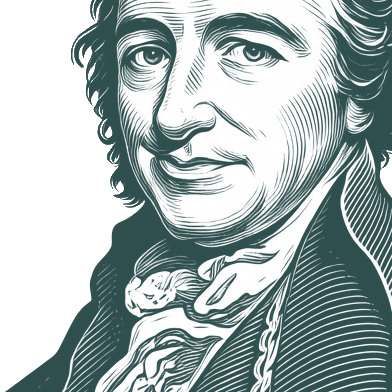
But the chief design of this paper is not to disprove it, which many have sufficiently done; but to entreat Americans to consider. - Thomas Paine
""
But the chief design of this paper is not to disprove it, which many have sufficiently done; but to entreat Americans to consider.
English
Collect this quote
About
Thomas Paine
Thomas Paine (February 9, 1737 [O.S. January 29, 1736] – 8 June 1809) was a British-American political writer, theorist, and activist who had a great influence on the thoughts and ideas which led to the American Revolution and the United States Declaration of Independence. He wrote three of the most influential and controversial works of the 18th Century: Common Sense, Rights of Man, and The Age of Reason. His ideas reflected Enlightenment-era ideals of transnational human rights.
Biography information from
Wikiquote·
Portrait adapted from
Wikimedia Commons, Auguste Millière / After George Romney / After William Sharp (Public domain / CC0)
Portrait from Wikimedia Commons. Credit: Auguste Millière / After George Romney / After William Sharp. Used under Public domain / CC0. Processed and styled by Quotewise.
Limited Time Offer
Premium members can get their quote collection automatically imported into their Quotewise collections.
There is an unnatural unfitness in an aristocracy to be legislators for a nation. Their ideas of distributive justice are corrupted at the very source. They begin life trampling on all their younger brothers and sisters, and relations of every kind, and are taught and educated so to do. With what ideas of justice or honor can that man enter a house of legislation, who absorbs in his own person the inheritance of a whole family of children, or metes out some pitiful portion with the insolence of a gift?
Government by kings was first introduced into the world by the Heathens, from whom the children of Israel copied the custom. It was the most prosperous invention the Devil ever set on foot for the promotion of idolatry. The Heathens paid divine honours to their deceased kings, and the Christian world hath improved on the plan, by doing the same to their living ones. How impious is the title of sacred majesty applied to a worm, who in the midst of his splendor is crumbling into dust!
PREMIUM FEATURE
Advanced Search Filters
Filter search results by source, date, and more with our premium search tools.
This sort of absurd subterfuge, and this manner of speaking of the Almighty, as one would speak of a man, is consistent with nothing but the stupidity of the Bible.