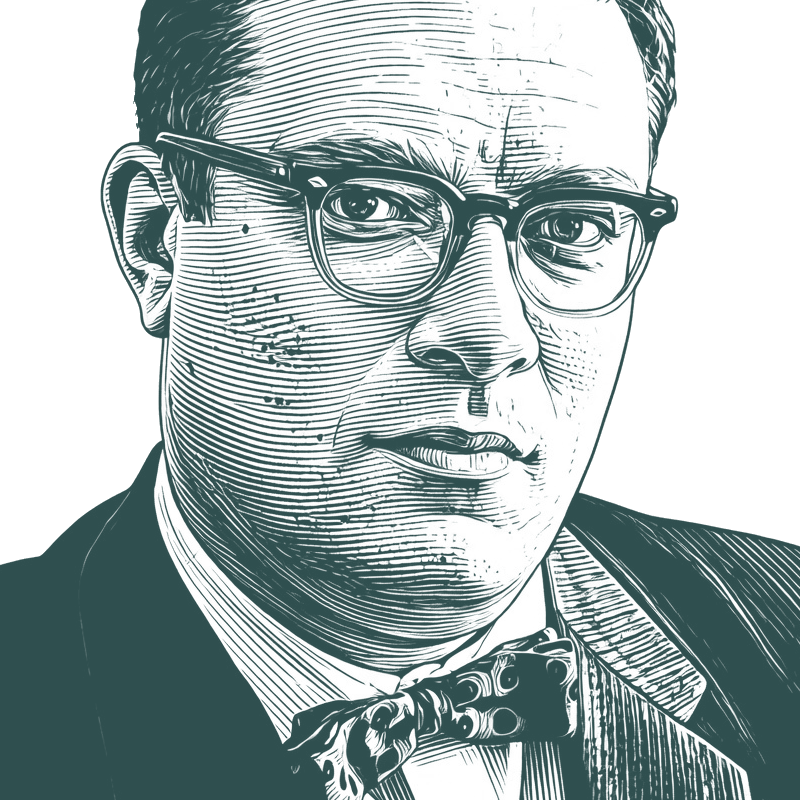
Legalistically, you may appeal to the Emperor, but would get no hearing. The Emperor today is not the Emperor of an Entun dynasty, you know. Trantor,… - Isaac Asimov
""
Legalistically, you may appeal to the Emperor, but would get no hearing. The Emperor today is not the Emperor of an Entun dynasty, you know. Trantor, I am afraid, is in the hands of the aristocratic families, members of which compose the Commission of Public Safety. This is a development which is well predicted by psychohistory.
Isaac Asimov (c. 2 January 1920 – 6 April 1992) was a Russian-born American biochemist who was a prolific writer of both fiction and non-fiction, his works include the Foundation series and I, Robot.
Biography information from
Wikiquote·
Portrait adapted from
Wikimedia Commons, Phillip Leonian [1] from New York World-Telegram & Sun.[2] (Public domain / CC0)
Also Known As
Alternative Names:
Isaak Osimov
•
Paul French
•
Asimov
•
Isaak Ozimov
•
Itzhak Ozimov
Portrait from Wikimedia Commons. Credit: Phillip Leonian [1] from New York World-Telegram & Sun.[2]. Used under Public domain / CC0. Processed and styled by Quotewise.
Go Premium
Support Quotewise while enjoying an ad-free experience and premium features.
Congratulations on the new library, because it isn't just a library. It is a space ship that will take you to the farthest reaches of the Universe, a time machine that will take you to the far past and the far future, a teacher that knows more than any human being, a friend that will amuse you and console you — and most of all, a gateway, to a better and happier and more useful life.
[Letters of Note; Troy (MI, USA) Public Library, 1971]
Trantor was a world in dregs and rebirth. Set like a faded jewel in the midst of the bewildering crowd of suns at the center of the Galaxy — in the heaps and clusters of stars piled high with aimless prodigality — it alternately dreamed of past and future.
PREMIUM FEATURE
Advanced Search Filters
Filter search results by source, date, and more with our premium search tools.
Ahora bien, no todos los blancos de la antigua Confederación se mostraban totalmente pasivos. En diciembre de 1865, un grupo de antiguos oficiales del ejército confederado formaron un grupo que llamaron Kyklos -palabra griega que significa círculo-, y puesto que muchos de ellos eran de ascendencia escocesa o irlandesa, se consideraban un clan, que escribían erróneamente klan por aliteración. El grupo pronto se pasó a llamarse Ku Klux Klan, y el antiguo general de caballería confederado Nathan Bedford Forrest, se convirtió en su primer gran maestre".