American writer and biochemist (1920–1992)
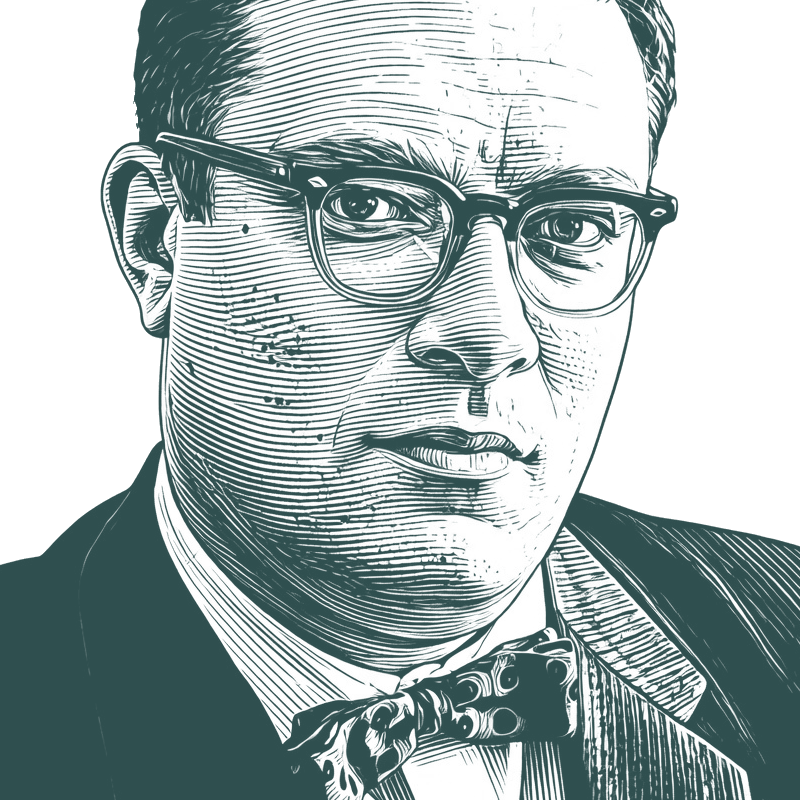
Isaac Asimov (c. 2 January 1920 – 6 April 1992) was a Russian-born American biochemist who was a prolific writer of both fiction and non-fiction, his works include the Foundation series and I, Robot.
Bio from: Wikiquote (CC BY-SA 4.0) · Portrait adapted from: Wikimedia Commons, Phillip Leonian [1] from New York World-Telegram & Sun.[2] (Public domain / CC0)
From Wikidata (CC0)
"And Mallow laughed joyously. "You've missed, Sutt, missed as badly as the Commdor himself. You've missed everything, and understood nothing. The Empire has always been a realm of colossal resources. They've calculated everything in planets, in stellar systems, in whole sectors of the Galaxy. Their generators are gigantic because they thought in gigantic fashion.
"But we, — we, our little Foundation, our single world almost without metallic resources, — have had to work with brute economy. Our generators have had to be the size of our thumb, because it was all the metal we could afford. We had to develop new techniques and new methods, — techniques and methods the Empire can't follow because they have degenerated past the stage where they can make any vital scientific advance.
"With all their nuclear shields, large enough to protect a ship, a city, an entire world; hey could never build one to protect a single man. To supply light and heat to a city, they have motors six stories high, — I saw them — where ours could fit into this room. And when I told one of their nuclear specialists that a lead container the size of a walnut contained a nuclear generator, he almost choked with indignation on the spot.
"Why, they don't even understand their own colossi any longer. The machines work from generation to generation automatically and the caretakers are a hereditary caste who would be helpless if a single D-tube in all that vast structure burnt out.
"The whole war is a battle between these two systems; between the Empire and the Foundation; between the big and the little. To seize control of a world, they bribe with immense ships that can make war, but lack all economic significance. We, on the other hand, bribe with little things, useless in war, but vital to prosperity and profits.
"A king, or a Commdor, will take the ships and even make war. Arbitrary rulers throughout history have bartered their subjects' welfare for what they consider honor, and glory, and conqu
Unlimited Quote Collections
Organize your favorite quotes without limits. Create themed collections for every occasion with Premium.
Asimov: Science fiction always bases its future visions on changes in the levels of science and technology. And the reason for that consistency is simply that—in reality—all other changes throughout history have been irrelevant and trivial. For example, what difference did it make to the people of the ancient world that Alexander the Great conquered the Persian Empire? Obviously, that event made some difference to a lot of individuals. But if you look at humanity in general, you'll see that life went on pretty much as it had before the conquest. On the other hand, consider the changes that were made in people's daily lives by the development of agriculture or the mariner's compass ... and by the invention of gunpowder or printing. Better yet, look at recent history and ask yourself, "What difference would it have made if Hitler had won World War II?" Of course, such a victory would have made a great difference to many people. It would have resulted in much horror, anguish, and pain. I myself would probably not have survived. But Hitler would have died eventually, and the effects of his victory would gradually have washed out and become insignificant—in terms of real change—when compared to such advances as the actual working out of nuclear power, the advent of television, or the invention of the jet plane.