Ivan Iylich saw that he was dying, and was in continual despair.
At the bottom of his heart Ivan Ilyich knew that he was dying; but so far from growi… - Leo Tolstoy
""
Ivan Iylich saw that he was dying, and was in continual despair. At the bottom of his heart Ivan Ilyich knew that he was dying; but so far from growing used to the idea, he simply did not grasp it - he was utterly unable to grasp it. The example of the syllogism that he had learned in Kiseveter's logic - Caius is a man, men are mortal, therefore Caius is mortal - had seemed to him all his life correct only as regards Caius, but not at all regards himself. In that case it was a question of Caius, a man, an abstract man, and it was perfectly true, but he was not Caius, and was not an abstract man; he had always been a creature quite, quite different from all the others.
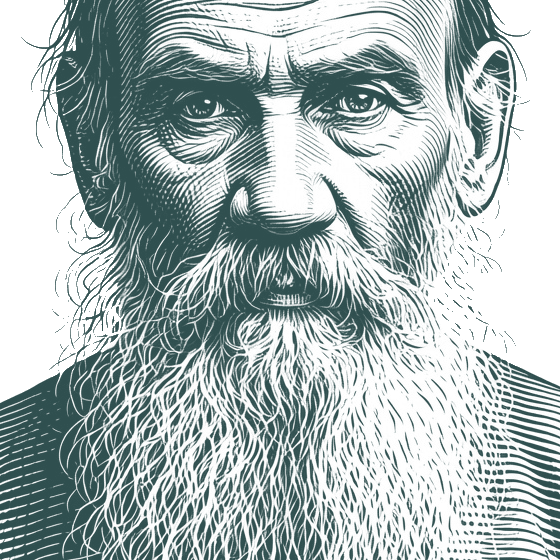
Lev Nikolayevitch Tolstoy [Ле́в Никола́евич Толсто́й, usually rendered Leo Tolstoy, or sometimes Tolstoi] (9 September 1828 – 20 November 1910) was a Russian writer, philosopher and social activist (social critic), whose novels War and Peace and Anna Karenina are internationally praised classics of world literature. He was a major influence on the development of Christian anarchism and pacifism, contributing to such nonviolent resistance movements as those of Mahatma Gandhi, Martin Luther King, Jr., and James Bevel.
Biography information from
Wikiquote·
Portrait adapted from
Wikimedia Commons, Sergei Prokudin-Gorskii (Public domain / CC0)
Also Known As
Pen Names:
Л. Н. Т.
•
Л. Н.
Birth Name:
Lev Nikolayevich Tolstoy
Native Name:
Лев Никола́евич Толсто́й
Alternative Names:
Count Lev Nikolayevich Tolstoy
•
Tolstoy, Leo, graf, 1828-1910
•
Tolstoĭ, Lev Nikolaevich, graf, 1828-1910
•
Lev Nikolayevich Tolstoĭ
•
Leo Tolstoi
•
Tolstoĭ, Lev Nikolaevich, graf
•
Tolstoy, Leo, graf
Related quotes. More quotes will automatically load as you scroll down, or you can use the load more buttons.
Shorter versions of this quote
Ivan Ilych saw that he was dying, and he was in continual despair. In the depth of his heart he knew he was dying, but not only was he not accustomed to the thought, he simply did not and could not grasp it. The syllogism he had learnt from Kiesewetter's Logic: "Caius is a man, men are mortal, therefore Caius is mortal," had always seemed to him correct as applied to Caius, but certainly not as applied to himself. That Caius — man in the abstract — was mortal, was perfectly correct, but he was not Caius, not an abstract man, but a creature quite, quite separate from all others.
These loaves, pigeons, and two little boys seemed unearthly. It all happened at the same time: a little boy ran over to a pigeon, glancing over at Levin with a smile; the pigeon flapped its wings and fluttered, gleaming in the sunshine among the snowdust quivering in the air, while the smell of freshly baked bread was wafted out of a little window as the loaves were put out. All this together was so extraordinarily wonderful that Levin burst out laughing and crying for joy.
In my considered opinion, salary is payment for goods delivered and it must conform to the law of supply and demand. If, therefore, the fixed salary is a violation of this law - as, for instance, when I see two engineers leaving college together and both equally well trained and efficient, and one getting forty thousand while the other only earns two thousand , or when lawyers and hussars, possessing no special qualifications, are appointed directors of banks with huge salaries - I can only conclude that their salaries are not fixed according to the law of supply and demand but simply by personal influence. And this is an abuse important in itself and having a deleterious effect on government service.
Works in ChatGPT, Claude, or Any AI
Add semantic quote search to your AI assistant via MCP. One command setup.
I know now that people only seem to live when they care only for themselves, and that it is by love for others that they really live. He who has Love has God in him, and is in God - - because God is Love.