The Soviets have been involved in the peace negotiations ever since 1973. The entire Geneva conference concept was established through the United Nat… - Jimmy Carter
""
The Soviets have been involved in the peace negotiations ever since 1973. The entire Geneva conference concept was established through the United Nations with the United States and with the Soviet Union as cochairmen. So, this has been established now for at least 4 years. And this is a concept that has been adopted and approved by all the parties involved, including the United Nations overwhelmingly, perhaps even unanimously. In the past, I think it's accurate to say that the Soviets have not played a constructive role in many instances because they had espoused almost completely the more adamant Arab position. My own feeling is that in recent months, the Soviets have moved toward a much more balanced position as a prelude to the Geneva conference. We have tried to spell out very clearly-certainly since I've been in office and, I think, my predecessors as well--the United States position. We disagree in some of those issues with the Soviet Union. We've not concealed those differences. We disagree in some instances because of the procedural items that are being discussed. But there is no division between us and the Soviet Union now that didn't exist before, and I would say that their positions have been much more compatible recently. I wish that the Soviets had decided to go to Cairo. They've decided not to. But we'll make as much progress as we can, following the leadership of Sadat and Begin, to make real progress in Cairo with the Soviets not present. And my belief is that the desire of the whole world is so great for peace in the Middle East that the Soviets will follow along and take advantage of any constructive step toward peace. The fact that we do have differences of opinion is well known and I don't think is an obstacle to eventual peace in the Middle East. But we did not bring the Soviets in. They have been in since the very initiation of a Geneva conference. Do you have a followup?
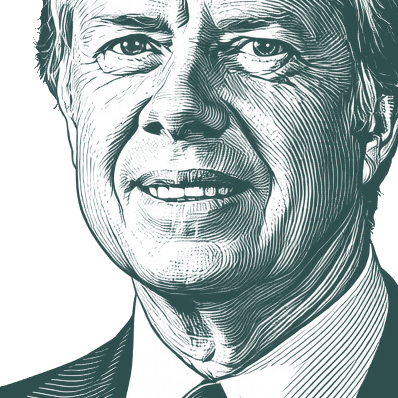
James Earl Carter, Jr. (October 1, 1924 – December 29, 2024) was an American politician and member of the Democratic Party who served as the 39th president of the United States from 1977 to 1981. In 1982 he established the Carter Center, as a base for promoting human rights, democracy, finding peaceful solutions to international conflicts, and advancing economic and social development, for which he was awarded the Nobel Peace Prize in 2002. He was a key figure in the Habitat for Humanity project, and has been noted for his criticism of Israel's role in the Israeli–Palestinian conflict.
Biography information from
Wikiquote·
Portrait adapted from
Wikimedia Commons, Department of Defense. Department of the Navy. Naval Photographic Center (Public domain / CC0)
Also Known As
Birth Name:
James Earl Carter Jr.
Alternative Names:
James E. Carter
•
James Carter
•
James Earl Carter
•
39th President of the United States
•
James E. Carter Jr.
•
James Earl Carter, Jr.
•
James E. Carter, Jr.
It is good to know that our nation's defenses against a conventional attack are impregnable, and an imperative that America remain vigilant against threats from terrorists. But as is the case with a human being, admirable characteristics of a nation are not defined by size and physical prowess. What are some of the other attributes of a superpower? Once again, they might very well mirror those of a person. These would include a demonstrable commitment to truth, justice, peace, freedom, humility, human rights, generosity, and the upholding of other moral values.
I would like to come down there as soon as I can. An important goal of my administration is to build up a renewed understanding and trust and communication with the nations and the people who live south of here in our hemisphere. My wife's already visited seven nations, as you know.
Go Premium
Support Quotewise while enjoying an ad-free experience and premium features.
Well, I believe that, obvious]y, the Cuban-Americans here have complete freedom. We are not committed to the destruction by military force of the present Cuban Government; our hope and aspiration is that maximum freedom for people who live in Cuba can be achieved. But I think at the time of the Bay of Pigs, our country gave up the thought that we might do it by military attack. We've proceeded very cautiously in our dealings with the Castro government. I've spelled out publicly on many occasions my own attitude toward this procedure. We have signed now with the Soviets-I mean with the Cubans--a fishers agreement and a maritime agreement. And we are continuing in practical application the anti-hijacking agreement which has not been renewed. We have also opened up the possibility, which will be realized very quickly, of diplomatic officials to be stationed in Washington and in Havana in the embassies of other nations. I don't see any possibility soon of normalizing relationships with Cuba. Castro's position has been that a prerequisite to this must be the removal of the trade embargo before negotiations can even commence. As I've said on numerous occasions, my concerns about Cuba are that they still have large numbers of political prisoners incarcerated that ought to be released. They have large numbers of troops in Angola and other places in Africa which ought to be returned. And they still maintain an attitude of unwarranted intrusion into the internal affairs of some of the other nations or places in the Western Hemisphere. So, I think all those factors tie together. But I assume from the tone of your question you were talking about a military overthrow of the Castro government. That is not part of our national purpose.