As for talkers and futile persons, they are commonly vain and credulous withal. For he that talketh what he knoweth, will also talk what he knoweth n… - Francis Bacon
""
As for talkers and futile persons, they are commonly vain and credulous withal. For he that talketh what he knoweth, will also talk what he knoweth not. Therefore set it down, that an habit of secrecy, is both politic and moral. And in this part, it is good that a man’s face give his tongue leave to speak. For the discovery of a man’s self, by the tracts of his countenance, is a great weakness and betraying; by how much it is many times more marked, and believed, than a man’s words.
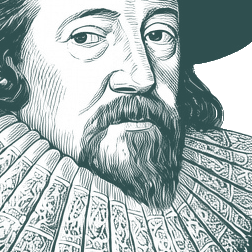
Francis Bacon, 1st Viscount St. Alban KC (22 January 1561 – 9 April 1626) was an English philosopher, statesman and essayist. His works argued for the possibility of scientific knowledge based only upon inductive reasoning and careful observation of events in nature. Most importantly, he argued this could be achieved by use of a sceptical and methodical approach whereby scientists aim to avoid misleading themselves. His general idea of the importance and possibility of a skeptical methodology makes Bacon the father of the scientific method. This marked a new turn in the rhetorical and theoretical framework for science, the practical details of which are still central in debates about science and methodology today.
Biography information from
Wikiquote·
Portrait adapted from
Wikimedia Commons, Paul van Somer I / Formerly attributed to Frans Pourbus the Younger (Public domain / CC0)
Also Known As
Alternative Names:
Franciscus Bacon
•
Francis Bacon of Verulamius
•
Francis Bacon, Lord Verulam
•
Bacon, Francis, 1561-1626
•
Francis Bacon, Viscount Saint Alban
Portrait from Wikimedia Commons. Credit: Paul van Somer I / Formerly attributed to Frans Pourbus the Younger. Used under Public domain / CC0. Processed and styled by Quotewise.
PREMIUM FEATURE
Advanced Search Filters
Filter search results by source, date, and more with our premium search tools.
[W]hen any of the four pillars of government are mainly shaken or weakened (which are religion, justice, counsel and treasure), men had need to pray for fair weather.
Virtue is like a rich stone, best plain set.
Atheism leaves a man to sense, to philosophy, to natural piety, to laws, to reputation; all which may be guides to an outward moral virtue, though religion were not; but superstition dismounts all these, and erecteth an absolute monarchy in the minds of men. Therefore atheism did never perturb states; for it makes men wary of themselves, as looking no further: and we see the times inclined to atheism (as the time of Augustus Cæsar) were civil times. But superstition hath been the confusion of many states, and bringeth in a new primum mobile, that ravisheth all the spheres of government. The master of superstition is the people; and in all superstition wise men follow fools; and arguments are fitted to practice, in a reversed order.