The idea of a king is to be a protector of the rich against unjust treatment, of the people against insult and oppression. Whereas a tyrant, as has o… - Aristotle
""
The idea of a king is to be a protector of the rich against unjust treatment, of the people against insult and oppression. Whereas a tyrant, as has often been repeated, has no regard to any public interest, except as conducive to his private ends; his aim is pleasure, the aim of a king, honor. Wherefore also in their desires they differ; the tyrant is desirous of riches, the king, of what brings honor. And the guards of a king are citizens, but of a tyrant mercenaries.
English
Collect this quote
About
Aristotle
Aristotle (Ἀριστοτέλης Aristotelēs; 384 BC – 322 BC) was a Greek philosopher and polymath during the Classical period in Ancient Greece. Taught by Plato, he was the teacher of Theophrastus and founder of the Lyceum, the Peripatetic school of philosophy, and the Aristotelian tradition. His writings cover many subjects including physics, biology, zoology, metaphysics, logic, ethics, aesthetics, poetry, theatre, music, rhetoric, psychology, linguistics, economics, politics, meteorology, geology and government. Aristotle provided a complex synthesis of the various philosophies existing prior to him. It was above all from his teachings that the West inherited its intellectual lexicon, as well as problems and methods of inquiry. As a result, his philosophy has exerted a unique influence on almost every form of knowledge in the West and it continues to be a subject of contemporary philosophical discussion.
Biography information from
Wikiquote·
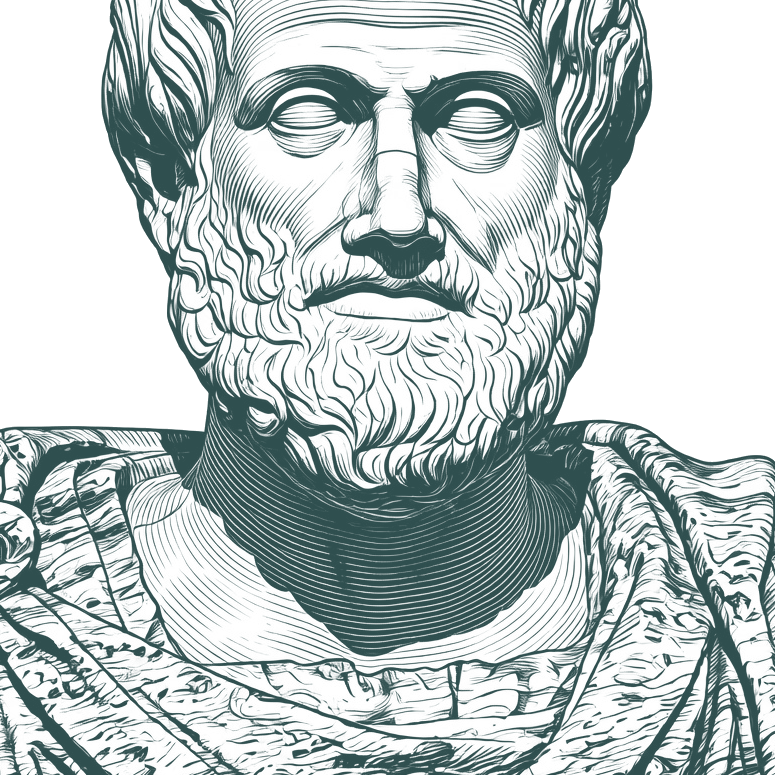
Portrait adapted from
Wikimedia Commons, After Lysippos (Public domain / CC0)
Also Known As
Native Name:
Ἀριστοτέλης
Alternative Names:
the Stagirite
•
Aristotelis
•
Aristoteles
The happy life is thought to be one of excellence; now an excellent life requires exertion, and does not consist in amusement. If Eudaimonia, or happiness, is activity in accordance with excellence, it is reasonable that it should be in accordance with the highest excellence; and this will be that of the best thing in us.
Since... nature is a principle of motion and mutation... it is necessary that we should not be ignorant of what motion is... But motion appears to belong to things continuous; and the infinite first presents itself to the view in that which is continuous. ...[F]requently ...those who define the continuous, employ the nature or the infinite, as if that which is divisible to infinity is continuous.
Go Premium
Support Quotewise while enjoying an ad-free experience and premium features.
In everything continuous and divisible, it is possible to grasp the more, the less, and the equal, and these either in reference to the thing itself, or in relation to us.