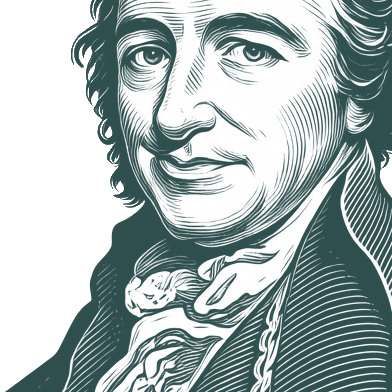
Thomas Paine (February 9, 1737 [O.S. January 29, 1736] – 8 June 1809) was a British-American political writer, theorist, and activist who had a great influence on the thoughts and ideas which led to the American Revolution and the United States Declaration of Independence. He wrote three of the most influential and controversial works of the 18th Century: Common Sense, Rights of Man, and The Age of Reason. His ideas reflected Enlightenment-era ideals of transnational human rights.
Biography information from
Wikiquote·
Portrait adapted from
Wikimedia Commons, Auguste Millière / After George Romney / After William Sharp (Public domain / CC0)
Portrait from Wikimedia Commons. Credit: Auguste Millière / After George Romney / After William Sharp. Used under Public domain / CC0. Processed and styled by Quotewise.
Go Premium
Support Quotewise while enjoying an ad-free experience and premium features.
As these people are not convicted of forfeiting freedom, they have still a natural, perfect right to it; and the Governments whenever they come should, in justice set them free, and punish those who hold them in slavery.
Loving, of enemies is another dogma of feigned morality, and has besides no meaning. It is incumbent on man, as a moralist, that he does not revenge an injury; and it is equally as good in a political sense, for there is no end to retaliation; each retaliates on the other, and calls it justice: but to love in proportion to the injury, if it could be done, would be to offer a premium for a crime. Besides, the word enemies is too vague and general to be used in a moral maxim, which ought always to be clear and defined, like a proverb. If a man be the enemy of another from mistake and prejudice, as in the case of religious opinions, and sometimes in politics, that man is different to an enemy at heart with a criminal intention; and it is incumbent upon us, and it contributes also to our own tranquillity, that we put the best construction upon a thing that it will bear. But even this erroneous motive in him makes no motive for love on the other part; and to say that we can love voluntarily, and without a motive, is morally and physically impossible.
Morality is injured by prescribing to it duties that, in the first place, are impossible to be performed, and if they could be would be productive of evil; or, as before said, be premiums for crime. The maxim of doing as we would be done unto does not include this strange doctrine of loving enemies; for no man expects to be loved himself for his crime or for his enmity.
Those who preach this doctrine of loving their enemies, are in general the greatest persecutors, and they act consistently by so doing; for the doctrine is hypocritical, and it is natural that hypocrisy should act the reverse of what it preaches. For my own part, I disown the doctrine, and consider it as a feigned or fabulous morality; yet the man does not exist that can say I have persecuted him, or any man, or any set of men, either in the American Revolution, or in the French Revolution; or that I have, in any case, returned evil for evil.
PREMIUM FEATURE
Advanced Search Filters
Filter search results by source, date, and more with our premium search tools.
The most detestable wickedness, the most horrid cruelties, and the greatest miseries, that have afflicted the human race have had their origin in this thing called revelation, or revealed religion. It has been the most dishonourable belief against the character of the divinity, the most destructive to morality, and the peace and happiness of man, that ever was propagated since man began to exist. It is better, far better, that we admitted, if it were possible, a thousand devils to roam at large, and to preach publicly the doctrine of devils, if there were any such, than that we permitted one such impostor and monster as Moses, Joshua, Samuel, and the Bible prophets, to come with the pretended word of God in his mouth, and have credit among us.
Whence arose all the horrid assassinations of whole nations of men, women, and infants, with which the Bible is filled; and the bloody persecutions, and tortures unto death and religious wars, that since that time have laid Europe in blood and ashes; whence arose they, but from this impious thing called revealed religion, and this monstrous belief that God has spoken to man? The lies of the Bible have been the cause of the one, and the lies of the Testament of the other.