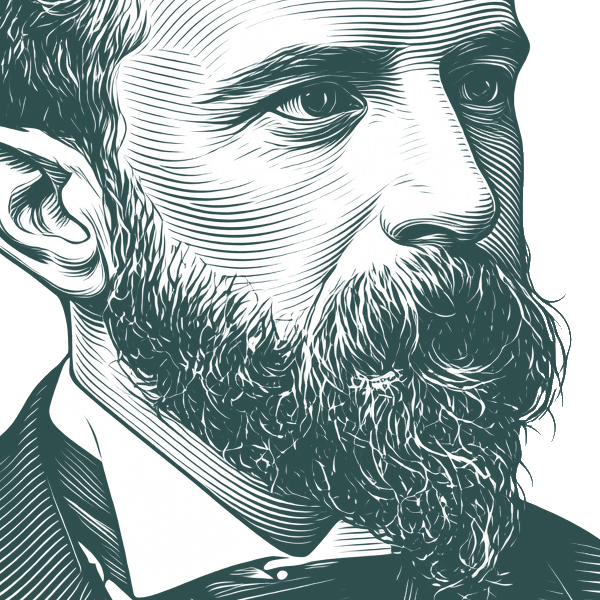
Creation was not successive; it was one instantaneous thought and act, identical with the will, and was complete and unchangeabble from end to end, i… - Henry Adams
""
Creation was not successive; it was one instantaneous thought and act, identical with the will, and was complete and unchangeabble from end to end, including time as one of its functions. Thomas was as clear as possible on that point:— "Supposing God wills anything in effect, he cannot will not to will it, because his will cannot change." He wills that some things shall be contingent and others necessary, but he wills in the same act that the contingency shall be necessary. "They are contingent because God has willed them to be so, and with this object has subjected them to causes which are so." In the same way he wills that his creation shall develop itself in time and space and sequence, but he creates these conditions as well as the events. He creates the whole, in one act, complete, unchangeable, and it is then unfolded like a rolling panorama with its predetermined contingencies. Man's free choice — liberum arbitrium — falls easily into place as a predetermined contingency. God is the First Cause, and acts in all Secondary Causes directly; but while he acts mechanically on the rest of creation,— as far as is known,— he acts freely at one point, and this free action remains free as far as it extends on that line. Man's freedom derives from this source, but it is simply apparent, as far as he is a cause; it is a [...] Reflex Action of the complicated mirror [...] called Mind, and [...] an illusion arising from the extreme delicacy of the machine.
Henry Brooks Adams (16 February 1838 – 27 March 1918) was a U.S. historian, journalist, novelist and educator. He was the great-grandson of John Adams, grandson of John Quincy Adams and son of Charles Francis Adams, Sr.
Biography information from
Wikiquote·
Portrait adapted from
Wikimedia Commons, William Notman (Public domain / CC0)
God, as Descartes justly said, we know! but what is man? The schools answered:— Man is a rational animal! So was apparently a dog, or a bee, or a beaver, none of which seemed to need churches. Modern science, with infinite effort, has discovered and announced that man is a bewildering complex of energies, which helps little to explain his relations with the ultimate Substance or Energy or Prime Motor whose existence both Science and Schoolmen admit; which Science studies in laboratories and Religion worships in churches. The Man whom God created to fill his Church, must be an energy independent of God; otherwise God filled his own Church with his own energy.
That Swinburne was altogether new to the three types of men-of-the-world before him; that he seemed to them quite original, wildly eccentric, astonishingly gifted, and convulsingly droll, Adams could see; but what more he was, even Milnes hardly dared say. They could not believe his incredible memory and knowledge of literature, classic, mediaeval, and modern; his faculty of reciting a play of Sophocles or a play of Shakespeare, forward or backward, from end to beginning; or Dante, or Villon, or Victor Hugo.
Works in ChatGPT, Claude, or Any AI
Add semantic quote search to your AI assistant via MCP. One command setup.
Science hesitates, more visibly than the Church ever did, to decide once for all whether unity or diversity is ultimate law; whether order or chaos is the governing rule of the universe, if universe there is; whether anything, except phenomena, exists.