Unlimited Quote Collections
Organize your favorite quotes without limits. Create themed collections for every occasion with Premium.
" "But the exceedingly foul deed of Onan, the basest of wretches, follows. Onan must have been a malicious and incorrigible scoundrel. This is a most disgraceful sin. It is far more atrocious than incest and adultery. We call it unchastity, yes a Sodomitic sin. For Onan goes in to her; that is, he lies with her and copulates, and when it comes to the point of insemination, spills the semen, lest the woman conceive. Surely at such a time the order of nature established by God in procreation should be followed. Accordingly, it was a most disgraceful crime to produce semen and excite the woman, and to frustrate her at that very moment.
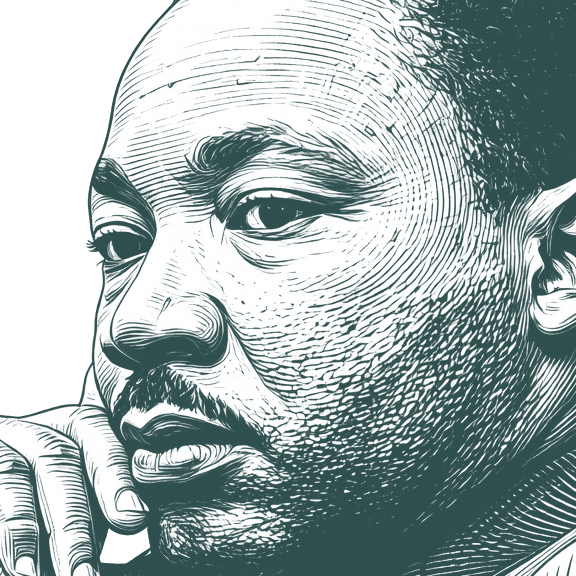
Dr. Martin Luther King Jr. (15 January 1929 – 4 April 1968) was an American Baptist minister, civil rights activist, and recipient of the Nobel Peace Prize of 1964. He was the husband of Coretta Scott King, and father of Yolanda King and Martin Luther King III.
Biography information from Wikiquote
Organize your favorite quotes without limits. Create themed collections for every occasion with Premium.
Related quotes. More quotes will automatically load as you scroll down, or you can use the load more buttons.
Returning hate for hate multiplies hate, adding deeper darkness to a night already devoid of stars. Darkness cannot drive out darkness: only light can do that. Hate cannot drive out hate: only love can do that. ... The chain reaction of evil — hate begetting hate, wars producing more wars — must be broken, or we shall be plunged into the dark abyss of annihilation.
I must say that when my Southern Christian Leadership Conference began its work in Birmingham, we encountered numerous Negro church reactions that had to be overcome. Negro ministers were among other Negro leaders who felt they were being pulled into something that they had not helped to organize. This is almost always a problem. Negro community unity was the first requisite if our goals were to be realized. I talked with many groups, including one group of 200 ministers, my theme to them being that a minister cannot preach the glories of heaven while ignoring social conditions in his own community that cause men an earthly hell. I stressed that the Negro minister had particular freedom and independence to provide strong, firm leadership, and I asked how the Negro would ever gain freedom without his minister's guidance, support and inspiration. These ministers finally decided to entrust our movement with their support, and as a result, the role of the Negro church today, by and large, is a glorious example in the history of Christendom. For never in Christian history, within a Christian country, have Christian churches been on the receiving end of such naked brutality and violence as we are witnessing here in America today. Not since the days of the Christians in the catacombs has God's house, as a symbol, weathered such attack as the Negro churches.
I shall never forget the grief and bitterness I felt on that terrible September morning when a bomb blew out the lives of those four little, innocent girls sitting in their Sunday-school class in the 16th Street Baptist Church in Birmingham. I think of how a woman cried out, crunching through broken glass, "My God, we're not even safe in church!" I think of how that explosion blew the face of Jesus Christ from a stained-glass window. It was symbolic of how sin and evil had blotted out the life of Christ. I can remember thinking that if men were this bestial, was it all worth it? Was there any hope? Was there any way out?... time has healed the wounds -- and buoyed me with the inspiration of another moment which I shall never forget: when I saw with my own eyes over 3000 young Negro boys and girls, totally unarmed, leave Birmingham's 16th Street Baptist Church to march to a prayer meeting -- ready to pit nothing but the power of their bodies and souls against Bull Connor's police dogs, clubs and fire hoses. When they refused Connor's bellowed order to turn back, he whirled and shouted to his men to turn on the hoses. It was one of the most fantastic events of the Birmingham story that these Negroes, many of them on their knees, stared, unafraid and unmoving, at Connor's men with the hose nozzles in their hands. Then, slowly the Negroes stood up and advanced, and Connor's men fell back as though hypnotized, as the Negroes marched on past to hold their prayer meeting. I saw there, I felt there, for the first time, the pride and the power of nonviolence.
Another time I will never forget was one Saturday night, late, when my brother telephoned me in Atlanta from Birmingham -- that city which some call "Bombingham" -- which I had just left. He told me that a bomb had wrecked his home, and that another bomb, positioned to exert its maximum force upon the motel room in which I had been staying, had injured several people. My brother described the terror in the streets as Negroes, furious at the bombings, fought whites. Then, behind his voice, I heard a rising chorus of beautiful singing: "We shall overcome." Tears came into my eyes that at such a tragic moment, my race still could sing its hope and faith.
Chat naturally about what you need. Each answer links back to real quotes with citations.