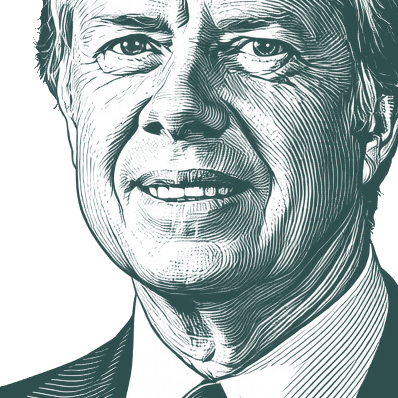
I have one life and one chance to make it count for something... My faith demands that I do whatever I can, wherever I am, whenever I can, for as lon… - Jimmy Carter
""
I have one life and one chance to make it count for something... My faith demands that I do whatever I can, wherever I am, whenever I can, for as long as I can with whatever I have to try to make a difference.
James Earl Carter, Jr. (October 1, 1924 – December 29, 2024) was an American politician and member of the Democratic Party who served as the 39th president of the United States from 1977 to 1981. In 1982 he established the Carter Center, as a base for promoting human rights, democracy, finding peaceful solutions to international conflicts, and advancing economic and social development, for which he was awarded the Nobel Peace Prize in 2002. He was a key figure in the Habitat for Humanity project, and has been noted for his criticism of Israel's role in the Israeli–Palestinian conflict.
Biography information from
Wikiquote·
Portrait adapted from
Wikimedia Commons, Department of Defense. Department of the Navy. Naval Photographic Center (Public domain / CC0)
Also Known As
Birth Name:
James Earl Carter Jr.
Alternative Names:
James E. Carter
•
James Carter
•
James Earl Carter
•
39th President of the United States
•
James E. Carter Jr.
•
James Earl Carter, Jr.
•
James E. Carter, Jr.
Portrait from Wikimedia Commons. Credit: Department of Defense. Department of the Navy. Naval Photographic Center. Used under Public domain / CC0. Processed and styled by Quotewise.
Enhance Your Quote Experience
Enjoy ad-free browsing, unlimited collections, and advanced search features with Premium.
I'm trying to approach the Government as a business manager and also as a small businessman who knows the defects in the Government. Our family has been brought very close together. We've had substantial success in the developing nations of the world in being reaccepted as a part of the world community who had some concern about them and who treated them with equality and mutual respect. I believe we've had a blessing in that we've not had a serious military threat. This, obviously, is something that I hope to maintain throughout my term in office. I hope that we've taken at least a small step forward in restoring the confidence of the American people in the integrity of the Government and the competence of Government. This is going to be a slow process. It's something that can't come in a year, or even 2 years, because with the horrible shocks of Vietnam and Watergate and the CIA revelations, the American people had lost confidence that there was something here in Washington that they could trust and admire. I think the most pleasant surprise to me has been the worldwide impact of our reemphasis on human rights. I really felt when I came into .office that something needed to be done just to raise a banner for the American people to admire and of which they could be proud again. I think that the emphasis on human personal freedom and democratic principles is very important for us to espouse. And although a year ago, I think, very few national leaders anywhere in the world paid much attention to human rights, I don't believe there's a single one out of the roughly 150 that now doesn't consider, "Before we take action, what is the world going to think about me, the way I'm dealing with political prisoners or out-migration or the reunification of families or the persecution of human beings?" I think the human rights issue has been a great escalation. We've also made a major move toward nonproliferation of nuclear explosives. And again, I think a year ago there was great despair in the world about whether anybody could ever put the nuclear genie back in the bottle. I think there's a reconfirmation now of effort on the part of even countries that have sold reprocessing plants, like Germany and France, all the rest of us, to try to stop the spread of nuclear explosives and not let it go into nations that haven't had them in the past. Those are a few things that come to mind.
To be true to ourselves, we must be true to others. We will not behave in foreign places so as to violate our rules and standards here at home, for we know that the trust which our Nation earns is essential to our strength.
Works in ChatGPT, Claude, or Any AI
Add semantic quote search to your AI assistant via MCP. One command setup.