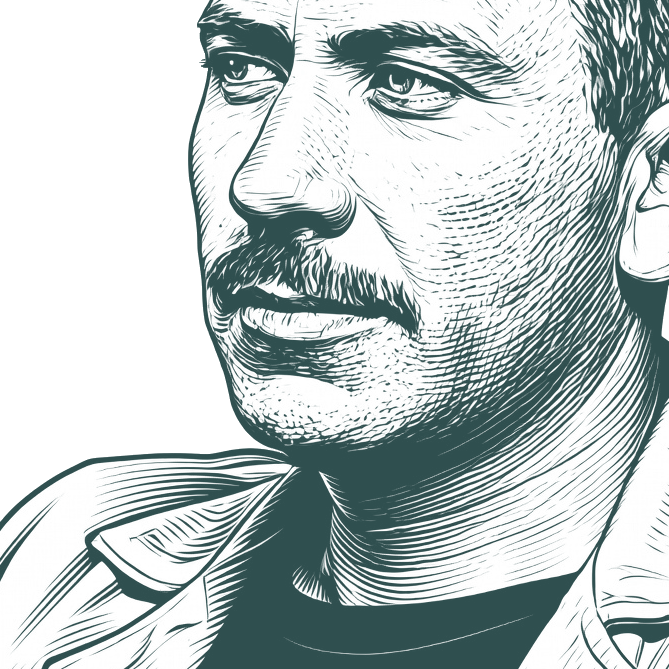
The hell with it! There ain't no sin and there ain't no virtue. There's just stuff people do. It's all part of nice, but that's as far as any man got… - John Steinbeck
""
The hell with it! There ain't no sin and there ain't no virtue. There's just stuff people do. It's all part of nice, but that's as far as any man got a right to say.
English
Collect this quote
About
John Steinbeck
John Ernst Steinbeck Jr. (27 February 1902 – 20 December 1968) was an American writer. A recipient of the Nobel Prize for Literature in 1962, his works include the novella Of Mice and Men (1937) and the novel The Grapes of Wrath (1939, Pulitzer Prize for Fiction, 1940), both of which examine the lives of the working class and migrant workers during the Great Depression.
Biography information from
Wikiquote·
Portrait adapted from
Wikimedia Commons, McFadden Publications, Inc.; no photographer credited; photo likely the work of Sonya Noskowiak, as Steinbeck is wearing the same clothes from her 1935 studio session that produced the work shown here: https://www.si.edu/object/npg_NPG.2006.74 (Public domain / CC0)
Also Known As
Birth Name:
Jeffery Ernest Steinbeck
Alternative Names:
John Ernst Steinbeck, Jr.
•
John Ernst Steinbeck
•
John Ernest Steinbeck
•
John Ernst Steinbeck Jr
•
Steinbeck
Portrait from Wikimedia Commons. Credit: McFadden Publications, Inc.; no photographer credited; photo likely the work of Sonya Noskowiak, as Steinbeck is wearing the same clothes from her 1935 studio session that produced the work shown here: https://www.si.edu/object/npg_NPG.2006.74. Used under Public domain / CC0. Processed and styled by Quotewise.
Try QuoteGPT
Chat naturally about what you need. Each answer links back to real quotes with citations.
Related quotes. More quotes will automatically load as you scroll down, or you can use the load more buttons.
Shorter versions of this quote
There ain't no sin and there ain't no virtue. There's just stuff people do.
The things we admire in men, kindness and generosity, openness, honesty, understanding and feeling are the concomiants of failure in our system. And those traits we detest, sharpness, greed, acquisitiveness, meanness, egotism and self-interest are the traits of success. And while men admire the quality of the first they love the produce of the second. (Cannery Row)
"I live alone," he said simply. "I live in the open. I hear the waves at night and see the black patterns of the pine boughs against the sky. With sound and silence and color and solitude, of course I see visions. Anyone would."
"But you don't believe in them?" Doc asked hopefully.
"I don't find it a matter for belief or disbelief," the seer said. "You've seen the sun flatten and take strange shapes just before it sinks into the ocean. Do you have to tell yourself everytime that it's an illusion caused by atmospheric dust and light distorted by the sea, or do you simply enjoy the beauty of it? Don't you see visions?"
"No," said Doc.
It is a fact verified and recorded in many histories that soul capable of the greatest good is also capable of the greatest evil. Who is there more impious than backsliding priest? Who more carnal than a recent virgin? This, however, may be a matter of appearance.