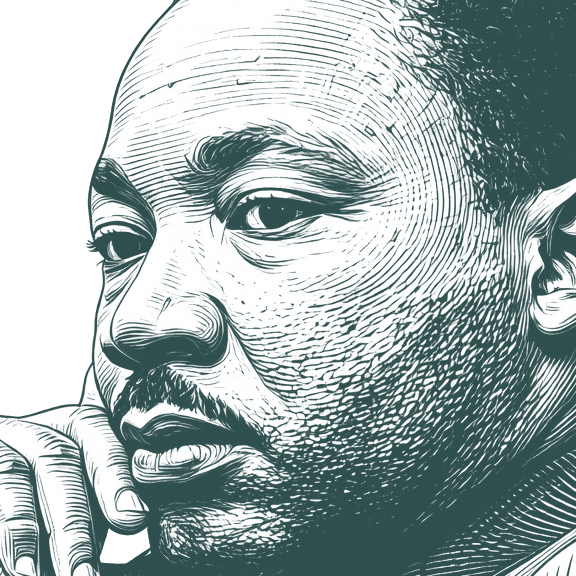
Women . . . have . . . small and narrow chests, and broad hips, to the end they should remain at home, sit still, keep house, and bear and bring up c… - Martin Luther King Jr.
""
Women . . . have . . . small and narrow chests, and broad hips, to the end they should remain at home, sit still, keep house, and bear and bring up children. . . . A woman is, or at least should be, a friendly, courteous, and a merry companion in life . . . the honor and ornament of the house, and inclined to tenderness, for thereunto are they chiefly created, to bear children, and to be the pleasure, joy and solace of their husbands.
Dr. Martin Luther King Jr. (15 January 1929 – 4 April 1968) was an American Baptist minister, civil rights activist, and recipient of the Nobel Peace Prize of 1964. He was the husband of Coretta Scott King, and father of Yolanda King and Martin Luther King III.
Biography information from
Wikiquote·
Portrait adapted from
Wikimedia Commons, Yoichi Okamoto (Public domain / CC0)
Also Known As
Birth Name:
Michael King Jr.
Alternative Names:
Martin Luther King, Jr.
•
Dr. Martin Luther King, Jr.
•
Martin Luther King
•
Michael King
•
Dr. King
•
M. L. King
•
M.L. King
•
ML King
•
MLK
•
Martin Luther King Junior
•
Michael King Junior
•
Rev. Dr. Martin Luther King Jr.
•
The Rev. Dr. Martin Luther King Jr.
It seems to be a fact of life that human beings cannot continue to do wrong without eventually reaching out for some thin rationalization to clothe the obvious wrong in the beautiful garments of righteousness. The philosopher-psychologist William James used to talk a great deal about the stream of consciousness. He says that the very interesting and unique thing about human nature is that man had the capacity temporarily to block the stream of consciousness and place anything in it that he wants to, and so we often end up justifying the rightness of the wrong. This is exactly what happened during the days of slavery. Even the Bible and religion were misused to crystallize the patterns of the status quo. And so it was argued from pulpits across the nation that the Negro was inferior by nature, because of Noah's curse upon the children of Ham. The apostle Paul's dictum became a watchword: Servants, be obedient to your master. And then one brother had probably studied the logic of the great philosopher Aristotle. You know Aristotle did a great deal to bring into being what we know as formal logic, and he talked about the syllogism, which had a major premise and a minor premise and a conclusion. And so this brother could put his argument in the framework of an Aristotelian syllogism. He could say, All men are made in the image of God. This was the major premise; then came the minor premise: God, as everybody knows, is not a Negro. Therefore, the Negro is not a man. This was the type of reasoning that prevailed.