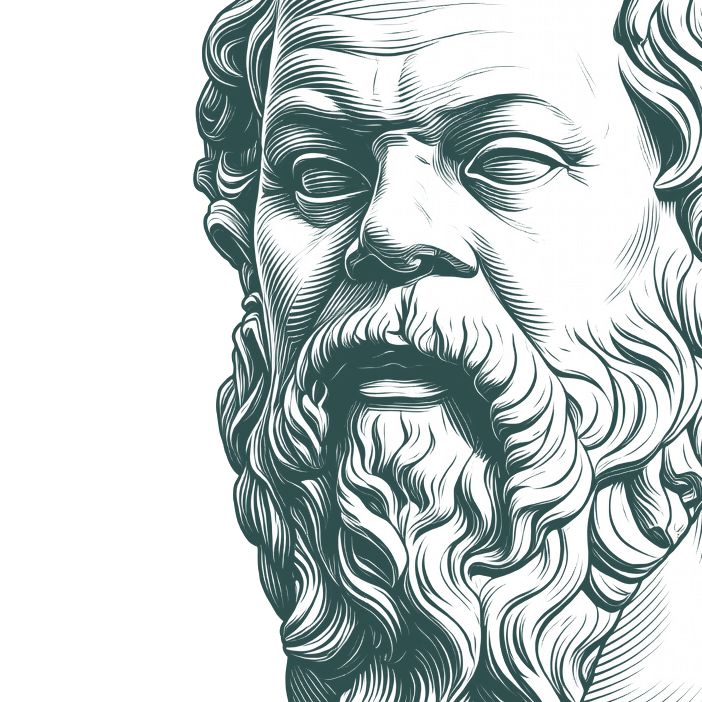
Think not those faithful who praise all thy words and actions; but those who kindly reprove thy faults. - Socrates
""
Think not those faithful who praise all thy words and actions; but those who kindly reprove thy faults.
English
Collect this quote
About
Socrates
Socrates (Σωκράτης; c. 470 BC – 399 BC) was a classical Greek (Athenian) philosopher credited as one of the founders of Western philosophy. Through his portrayal in Plato's dialogues, Socrates has become renowned for his contribution to the field of ethics, and it is this Platonic Socrates who lends his name to the concepts of Socratic irony and the Socratic method, or elenchus. The latter remains a commonly used tool in a wide range of discussions, and is a type of pedagogy in which a series of questions is asked not only to draw individual answers, but also to encourage fundamental insight into the issue at hand.
Biography information from
Wikiquote·
Portrait adapted from
Wikimedia Commons, Copy of Lysippos (?) (Public domain / CC0)
And the same things look bent and straight when seen in water and out of it, and also both concave and convex, due to the sight’s being mislead by the colors, and every sort of confusion of this kind is plainly in our soul. And, then, it is because they take advantage of this affection in our nature that shadow painting, and puppeteering, and many other tricks of the kind fall nothing short of wizardry.
Life without enquiry is not worth living.
Enhance Your Quote Experience
Enjoy ad-free browsing, unlimited collections, and advanced search features with Premium.