Levin had been married three months. He was happy, but not at all in the way he had expected to be. At every step he found his former dreams disappoi… - Leo Tolstoy
""
Levin had been married three months. He was happy, but not at all in the way he had expected to be. At every step he found his former dreams disappointed, and new, unexpected surprises of happiness. He was happy; but on entering upon family life he saw at every step that it was utterly different from what he had imagined. At every step he experienced what a man would experience who, after admiring the smooth, happy course of a little boat on a lake, should get himself into that little boat. He saw that it was not all sitting still, floating smoothly; that one had to think too, not for an instant to forget where one was floating; and that there was water under one, and that one must row; and that his unaccustomed hands would be sore; and that it was only to look at it that was easy; but that doing it, though very delightful, was very difficult.
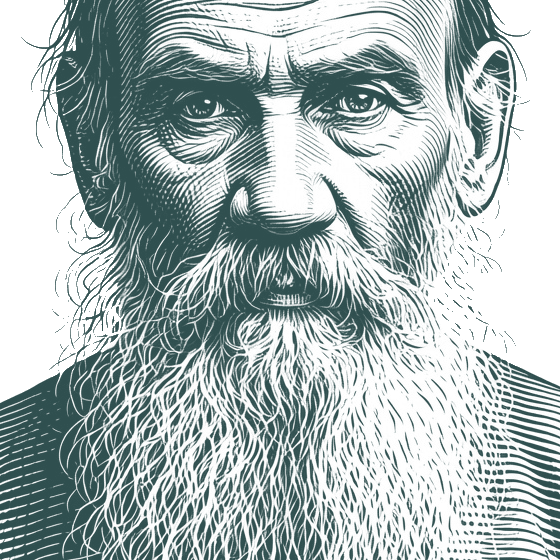
Lev Nikolayevitch Tolstoy [Ле́в Никола́евич Толсто́й, usually rendered Leo Tolstoy, or sometimes Tolstoi] (9 September 1828 – 20 November 1910) was a Russian writer, philosopher and social activist (social critic), whose novels War and Peace and Anna Karenina are internationally praised classics of world literature. He was a major influence on the development of Christian anarchism and pacifism, contributing to such nonviolent resistance movements as those of Mahatma Gandhi, Martin Luther King, Jr., and James Bevel.
Biography information from
Wikiquote·
Portrait adapted from
Wikimedia Commons, Sergei Prokudin-Gorskii (Public domain / CC0)
Also Known As
Pen Names:
Л. Н. Т.
•
Л. Н.
Birth Name:
Lev Nikolayevich Tolstoy
Native Name:
Лев Никола́евич Толсто́й
Alternative Names:
Count Lev Nikolayevich Tolstoy
•
Tolstoy, Leo, graf, 1828-1910
•
Tolstoĭ, Lev Nikolaevich, graf, 1828-1910
•
Lev Nikolayevich Tolstoĭ
•
Leo Tolstoi
•
Tolstoĭ, Lev Nikolaevich, graf
•
Tolstoy, Leo, graf
Rest, nature, books, music…such is my idea of happiness.
We know very well that we are only allowed to go on eating our dinner, to finish seeing the new play, or to enjoy to the end the ball, the Christmas fete, the promenade, the races or, the hunt, thanks to the policeman's revolver or the soldier's rifle, which will shoot down the famished outcast who has been robbed of his share, and who looks round the corner with covetous eyes at our pleasures, ready to interrupt them instantly, were not policeman and soldier there prepared to run up at our first call for help.
Enhance Your Quote Experience
Enjoy ad-free browsing, unlimited collections, and advanced search features with Premium.
The whole world knows that virtue consists in the subjugation of one's passions, or in self-renunciation. It is not just the Christian world, against whom Nietzsche howls, that knows this, but it is an eternal supreme law towards which all humanity has developed, including Brahmanism, Buddhism, Confucianism, and the ancient Persian religion. And suddenly a man appears who declares that he is convinced that self-renunciation, meekness, submissiveness and love are all vices that destroy humanity (he has in mind Christianity, ignoring all the other religions). One can understand why such a declaration baffled people at first. But after giving it a little thought and failing to find any proof of the strange propositions, any rational person ought to throw the books aside and wonder if there is any kind of rubbish that would not find a publisher today. But this has not happened with Nietzsche´s books. The majority of pseudo-enlightened people seriously look into the theory of the Übermensch, and acknowledge its author to be a great philosopher, a descendant of Descartes, Leibniz and Kant. And all this has come about because the majority of pseudo-enlightened men of today object to any reminder of virtue, or to its chief premise: self-renunciation and love—virtues that restrain and condemn the animal side of their life. They gladly welcome a doctrine, however incoherently and disjointedly expressed, of egotism and cruelty, sanctioning the idea of personal happiness and superiority over the lives of others, by which they live.