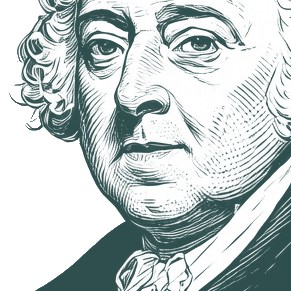
John Adams (30 October 1735 – 4 July 1826) was an American lawyer, author, statesman, and diplomat. He served as the second president of the United States (1797–1801), the first vice president (1789–1797), and as a Founding Father was a leader of American independence from the British Empire. Adams was a political theorist in the Age of Enlightenment who promoted republicanism and a strong central government. His innovative ideas were frequently published. He was also a dedicated diarist and correspondent, particularly with his wife and key advisor Abigail. He was the father of John Quincy Adams.
Biography information from
Wikiquote·
Portrait adapted from
Wikimedia Commons, Gilbert Stuart (Public domain / CC0)
We are told: "It is a universal truth, that he that would excite a rebellion, is at heart as great a tyrant as ever wielded the iron rod of oppression." Be it so. We are not exciting a rebellion. Opposition, nay, open, avowed resistance by arms, against usurpation and lawless violence, is not rebellion by the law of God or the land. Resistance to lawful authority makes rebellion. … Remember the frank Veteran acknowledges, that "the word rebel is a convertible term."
As to the history of the revolution, my ideas may be peculiar, perhaps singular. What do we mean by the Revolution? The war? That was no part of the revolution; it was only an effect and consequence of it. The revolution was in the minds of the people, and this was effected from 1760–1775, in the course of fifteen years, before a drop of blood was shed at Lexington.
Unlimited Quote Collections
Organize your favorite quotes without limits. Create themed collections for every occasion with Premium.
Let the bar proclaim, "the laws, the rights, the generous plan of power" delivered down from remote antiquity, inform the world of the mighty struggles and numberless sacrifices made by our ancestors in defense of freedom. Let it be known, that British liberties are not the grants of princes or parliaments, but original rights, conditions of original contracts, coequal with prerogative, and coeval with government; that many of our rights are inherent and essential, agreed on as maxims, and established as preliminaries, even before a parliament existed. Let them search for the foundations of British laws and government in the frame of human nature, in the constitution of the intellectual and moral world. There let us see that truth, liberty, justice, and benevolence, are its everlasting basis; and if these could be removed, the superstructure is overthrown of course.